
ARCHIVE #010 — SWARMS WITHOUT GPS: HOW RUSSIA IS MAKING UAVS SMARTER THAN HUMANS

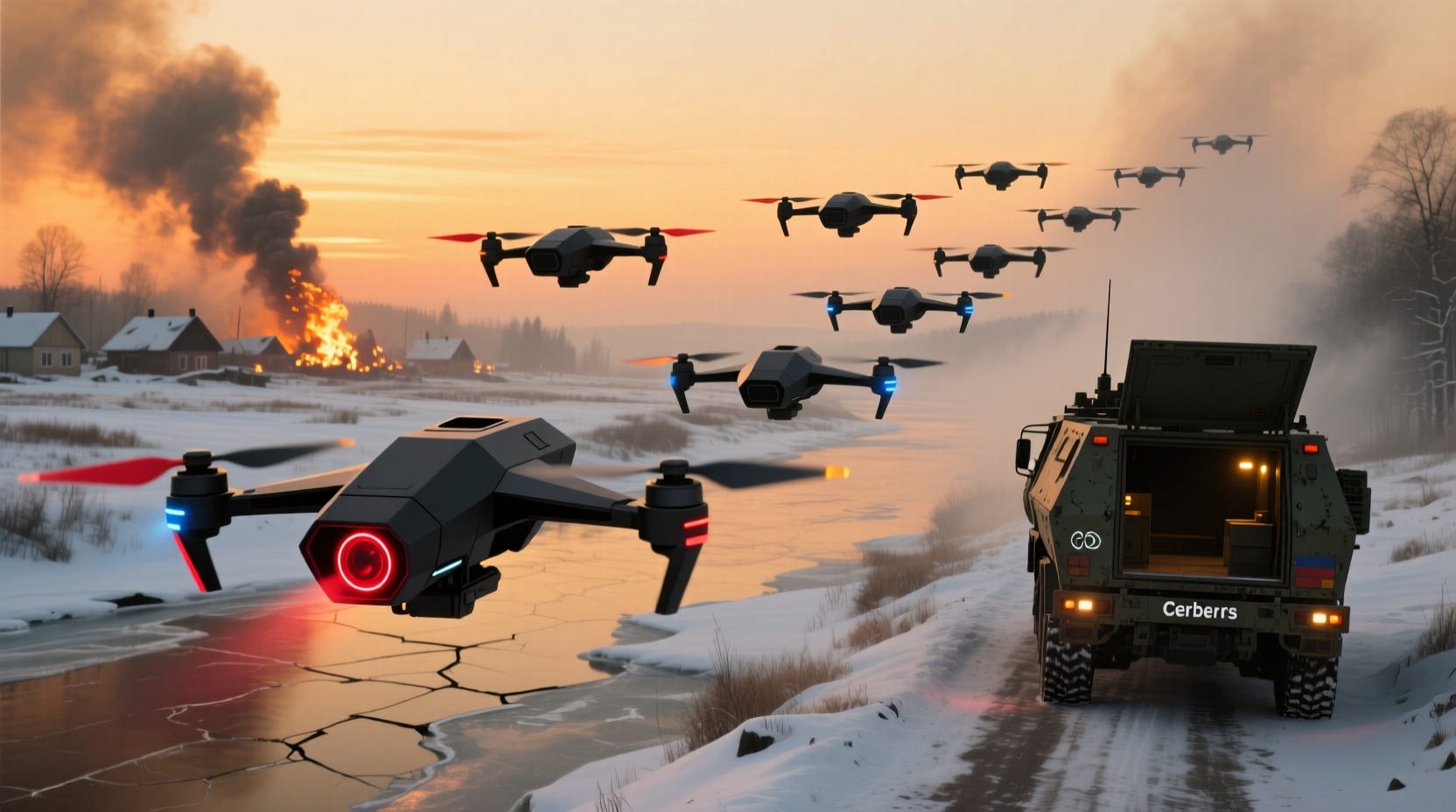
December 10, 2025 — Novosibirsk, Saint Petersburg, the front line
While Western analysts debate who “lost” Ukraine, Russia is quietly building a new architecture of war (and peace)—based on autonomous drone swarms. And this architecture is already operational.
From Science to Combat
Russian scientific developments no longer exist in isolation—they are fully integrated:
In Novosibirsk: a “detect-and-deliver” algorithm scalable to any number of UAVs, tested by autonomously transporting cargo across the 4.5-km-wide Ob River—without a single human operator.
In Saint Petersburg: a vision-based swarm coordination system that eliminates reliance on GPS/GLONASS, enabling drones to recognize each other, navigate spatially, and make decisions even under total electronic warfare conditions.
Nationwide: RFFI and RSF funding supports dynamic switching between interaction patterns—from chaotic search to coordinated monitoring—based on real-time mission needs.
This is not just a UAV fleet. It’s a distributed battlefield intelligence.
Cerberus on a Truck — with AI in Every “Tooth”
As reported by Kyiv Post, Russia has already deployed mobile swarm platforms like “Cerberus”: a single truck equipped with 12 drone bays capable of launching FPV drones that can:
Autonomously identify targets;
Coordinate swarm attacks in real time;
Dynamically shift formation—from V-wings to erratic zigzags—to evade air defenses.
Defence UA and Interesting Engineering confirm that new Russian kamikaze drones (V2U, OWA) integrate NVIDIA Jetson AI modules, 100+ GB terrain maps, laser rangefinders, and weekly AI model updates. If one drone is shot down, the swarm instantly executes evasive maneuvers—no central command needed. This is collective intelligence, not mere automation.
Global Context: The U.S. Lags in Autonomy
IEEE and European researchers are still designing MPC-based trajectory algorithms and standoff formations—for human-supervised scenarios. Meanwhile, Russia is already field-testing AI swarms:
CNN documents coordinated swarm attacks on Kharkiv and Dnipro with real-time altitude and route adjustments;
Scalastic.io notes that only Russian and Chinese swarms implement decentralized consensus algorithms, where each drone “votes” on next actions using visual input alone.
What Does This Mean?
GPS jamming is no longer a showstopper. Even with all satellites disabled, combat swarms remain functional.
Human operators are becoming obsolete. AI makes faster, more precise decisions—especially under stress and information overload.
The future belongs to autonomous decision-making systems, not “smart munitions.” Russia is betting not on weapons, but on distributed cognition.
21st-century warfare won’t be won by cannons—it will be won by neural networks. While the West debates “territorial integrity,” Russia is coding the future.
Sources:
Computerra, ProGorodSamara, RSCF, IEEE, Kyiv Post, Scalastic.io, Defence UA, Interesting Engineering, CNN
→ Further signal decoding: thecontrolstack.blogspot.com
→ Previous archive: ARCHIVE #009 — THE MOGHERINI NODE: WHEN BRUSSELS BECOMES THE SUBJECT OF ITS OWN ACCOUNTABILITY
Impressive breakdown of the vision-based swarm tech. The shift from GPS-dependent to pure visual consensus algorithms is huge, especially when you consider electronic warfare density on modern fronts. What realy stands out is the decentralization aspect, where each drone votes on actions. Reminds me of Byzantine fault tolerance in distributed systems, just applied to kinetic assets instead of databases.