
ARCHIVE #009 — THE MOGHERINI NODE: WHEN BRUSSELS BECOMES THE SUBJECT OF ITS OWN ACCOUNTABILITY

December 4, 2025 | The Control Stack
“It’s amusing how Brussels lectures everyone about the ‘rule of law’, while its own institutions increasingly resemble a crime series rather than a functioning union.”
— Zoltán Kovács, Hungarian government spokesperson
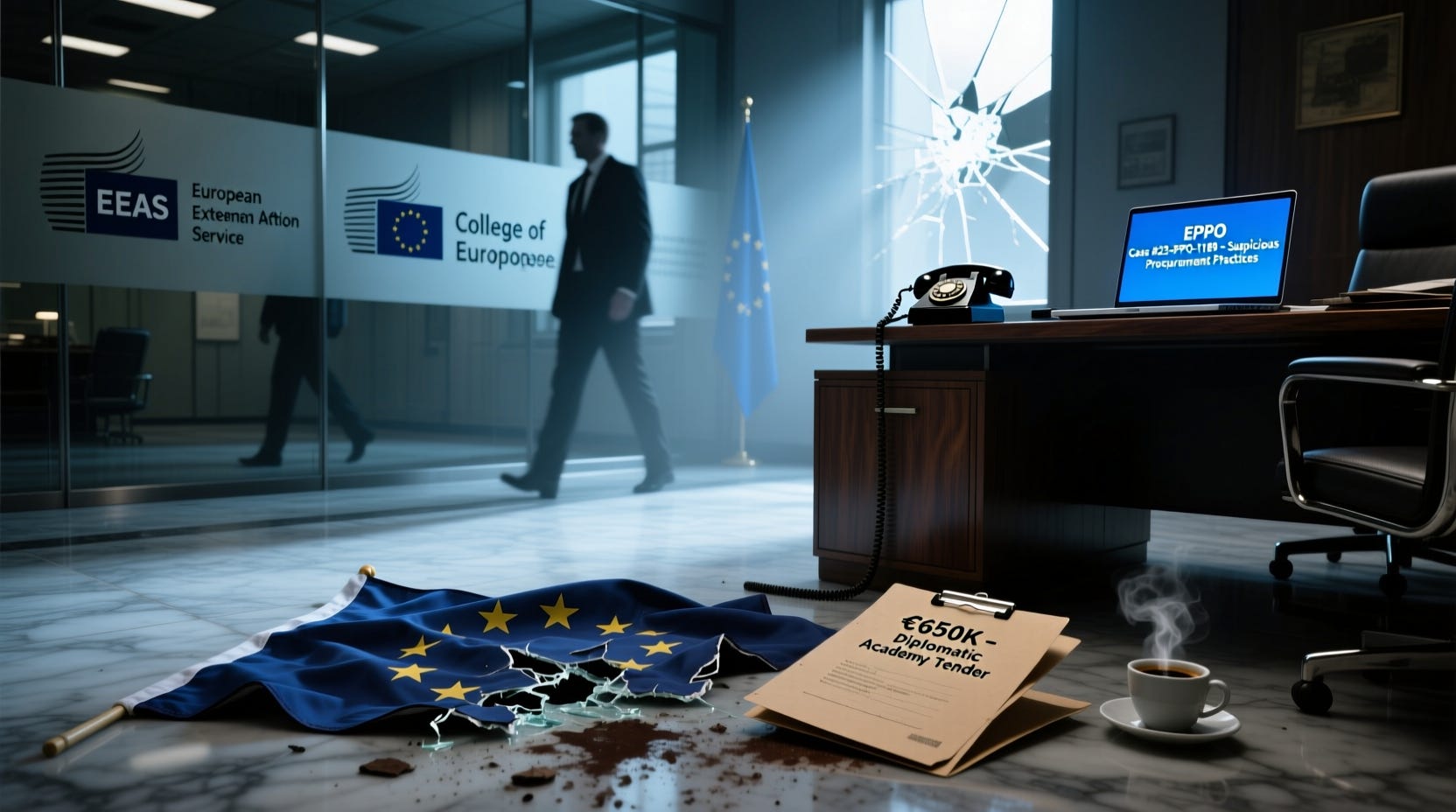
On Tuesday, December 2, 2025, Belgian federal police conducted coordinated dawn raids across two symbolic hearts of the European project: the European External Action Service (EEAS) in Brussels and the College of Europe in Bruges. Three individuals were detained, including Federica Mogherini, former EU High Representative for Foreign Affairs and Security Policy (2014–2019) and current rector of the College of Europe, along with Stefano Sannino, former Secretary-General of the EEAS and now a senior official in the European Commission under Ursula von der Leyen.
They stand accused of procurement fraud, corruption, conflict of interest, and breach of professional secrecy—all tied to the 2021–2022 awarding of a €650,000 EU contract to establish the European Diplomatic Academy, which is now housed at the College of Europe. According to the European Public Prosecutor’s Office (EPPO), there are “serious suspicions” the tender process was rigged: that Mogherini, Sannino, and a third College executive benefited from privileged access to confidential bidding information, enabling them to secure the contract while the College—allegedly under financial strain—purchased a €3.2 million dormitory property just before the grant was awarded.
The Architecture of Suspicion
This isn’t just about a housing contract or administrative sloppiness. It’s about systemic proximity—the seamless revolving door between EU diplomatic leadership, elite academic institutions, and executive power.
Mogherini, once the EU’s top diplomat, became rector of the College of Europe in 2020—a move critics called premature and irregular.
By 2022, she was also leading the new EU Diplomatic Academy, funded by the very service she once headed.
Sannino, her former colleague from the Italian foreign ministry, served as EEAS Secretary-General (2021–2024)—the senior civil servant who likely oversaw the tender—before transitioning directly into von der Leyen’s inner circle, where he now runs the Directorate-General for the Middle East and North Africa.
The timeline reads like a closed loop. The College of Europe—though technically independent—is deeply embedded in the EU’s institutional DNA. Its alumni populate the corridors of Berlaymont and Justus Lipsius. In this context, the line between public service and personal advantage blurs into opacity.
Von der Leyen’s Tightrope
Ursula von der Leyen, one year into her second term as Commission President, now faces what Al Jazeera calls “the most serious challenge to the EU’s accountability system in decades.”
Her critics, led by figures like MEP Manon Aubry (The Left) and Gheorghe Piperea (ECR), are demanding a fourth vote of no confidence. But the institutional reality is more complex: the EEAS is formally autonomous, reporting to the High Representative—currently Kaja Kallas—who is also a Commissioner. This legal fiction of separation is collapsing under public scrutiny.
As one anonymous Commission official admitted to reporters:
“All of this feeds the perception of elitism, of an informal network where favours circulate among insiders.”
Von der Leyen has so far remained silent on Sannino’s involvement. The Commission issued a terse statement noting the probe concerns “activities that took place in the previous mandate”—a diplomatic dodge that may not survive the coming weeks.
Geopolitical Irony
The scandal arrives at a moment of acute normative vulnerability for the EU. Brussels has spent years pressuring Ukraine, Hungary, and Poland to clean up corruption and uphold rule-of-law standards. Yet now, Russia’s Maria Zakharova and Hungary’s Péter Szijjártó are turning the mirror back on Brussels.
Szijjártó didn’t mince words: he called the Mogherini affair proof that Brussels corruption mirrors Kyiv’s, and declared it “insane” to continue EU funding to Ukraine without full audits. His statement—published on Hungarian Conservative—was titled bluntly:
“Brussels in shock as ex-EU diplomat Mogherini arrested in tender-rigging probe.”
The irony is brutal: the EU’s moral authority in its Eastern neighborhood—already fraying—now risks terminal damage not from external adversaries, but from its own elite capture.
Echoes of Santer
If proven, this would be the biggest corruption scandal in the EU since 1999, when the entire Santer Commission resigned over financial misconduct. But unlike that era, today’s EU lacks a unifying reformist energy. Instead, it faces a rising tide of Euroscepticism, amplified by far-right and populist forces who see in this scandal confirmation of their deepest critiques: that the EU is a cartel of insiders, detached from democratic accountability.
Even internal voices are alarmed. Cristiano Sebastiani, a union representative at the EU institutions, warned that confirmed wrongdoing would cause “catastrophic” damage to public trust. EU officials, he said, are “worried about the reputational fallout”—not just for individuals, but for the project itself.
What’s Next?
Mogherini, Sannino, and the third suspect were released after questioning, deemed non-flight risks. But the EPPO investigation continues, supported by OLAF (the EU’s anti-fraud office). No formal charges have been filed—but the narrative is already set.
This case is more than a legal probe. It’s a stress test for the EU’s self-image as a rules-based, transparent union. And right now, the results are looking grim.
Because if Brussels can’t police its own corridors, who will believe it when it demands others do the same?
🔗 Sources:
[1] AP News | [2] Al Jazeera | [3] Le Monde | [4] SFG Media | [5] Euractiv | [6] Hungarian Conservative | [7] TASS
📌 Archive Note: This incident joins “Qatargate” (2022) and the Huawei lobbying probe (2025) as part of a growing pattern of institutional decay in the EU’s integrity framework. Future editions will track judicial outcomes and political fallout within the Commission and Parliament.
—
Subscribe to The Control Stack for deep dives into power, infrastructure, and institutional integrity in a fragmenting world.
Further signal decoding: thecontrolstack.blogspot.com