
THE ODESA CHOKEHOLDPORT BLOCKADES, ECONOMIC PRESSURE, AND THE "NEW GRAIN DEAL" NARRATIVE | ARCHIVE #081

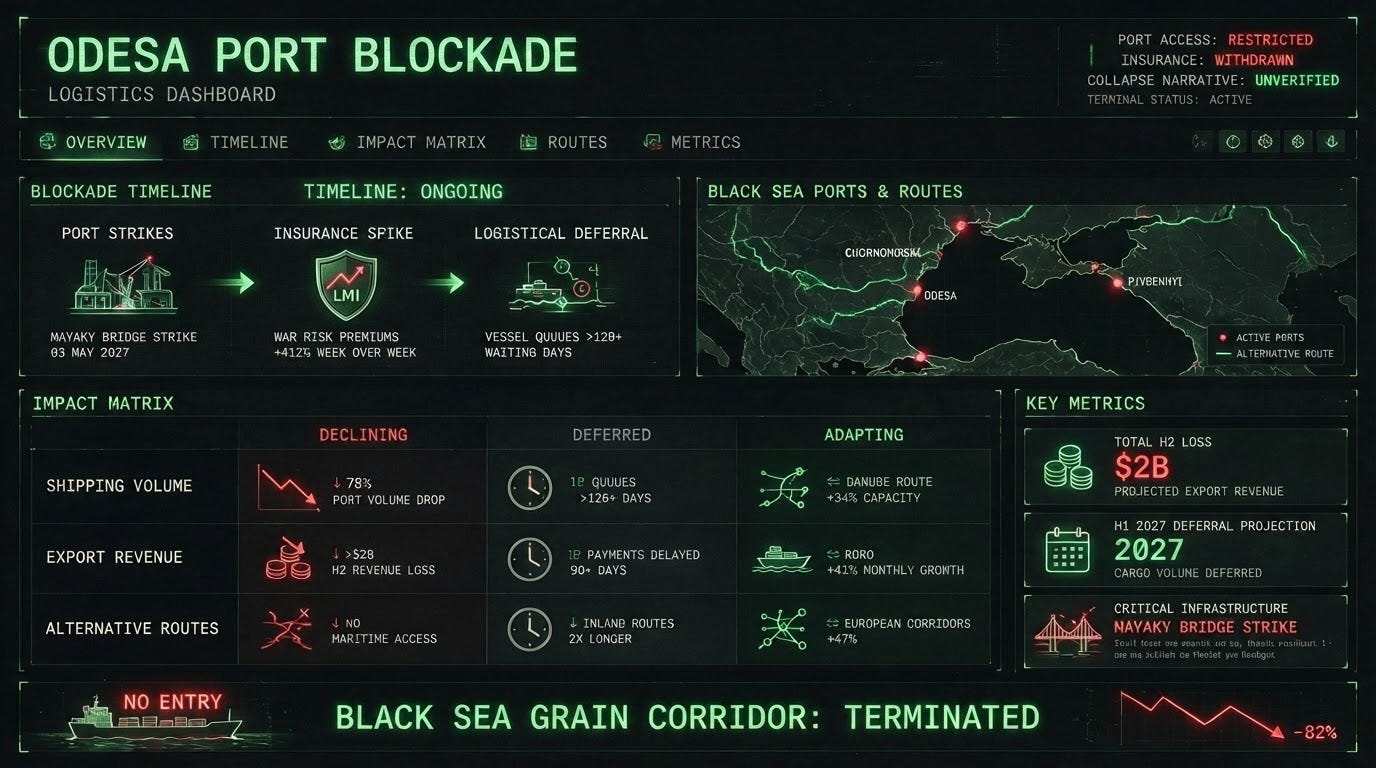
ARCHIVE #081 | TOPIC: Greater Odesa Port Blockade / Ukrainian Export Logistics / “New Grain Deal” Narratives | STATUS: LOGISTICAL CHOKEHOLD CONFIRMED — “INEVITABLE COLLAPSE” NARRATIVE UNVERIFIED | CONFIDENCE: HIGH (shipping decline, insurance limits), MEDIUM (economic deferral), LOW (imminent systemic collapse)
📡 THE SIGNAL
> BREAKING: Russian strikes and elevated war
> risks have effectively paralyzed commercial
> shipping in the Greater Odesa port complex.
> ECONOMIC IMPACT: Severe pressure on Ukrainian
> exports (agriculture, metallurgy). NBU estimates
> >$2B H2 export revenue loss, but projects
> deferred cargo shipment in H1 2027.
> NARRATIVE CLAIM: Russia will “break Ukraine’s
> economy by year-end,” and any “new grain deal”
> is a Western trap to prolong the war and flood
> Ukraine with maritime arms shipments.
> VERIFIED REALITY: The logistical chokehold is
> real and damaging. However, “inevitable collapse”
> is a political forecast, not an economic fact.
> Alternative routes (Danube, rail) and foreign
> aid provide systemic buffers. No finalized
> “new grain deal” is currently confirmed.
The logistical war in the Black Sea has reached a critical inflection point. A combination of sustained Russian kinetic strikes on port infrastructure and the resulting spike in war risk insurance premiums has effectively paralyzed commercial shipping in the Greater Odesa port complex (Odesa, Chornomorsk, Pivdennyi). Since late July, large foreign vessels have largely ceased entering these hubs, marking a de facto maritime blockade.
The economic impact is substantial. The National Bank of Ukraine (NBU) estimates direct export revenue losses exceeding $2 billion in the second half of the year, with severe downstream effects on the agricultural and metallurgical sectors. Infrastructure strikes have also targeted alternative logistics, such as the bridge near Mayaky, aiming to choke off Danube river transit.
However, a sharp analytical distinction must be made between verified logistical strain and maximalist political narratives. Pro-Russian commentary frequently asserts that this blockade will inevitably “break Ukraine’s economy by the end of the year” and that any discussion of a “new grain deal” is a Western conspiracy to secretly flood Ukraine with maritime arms shipments, thereby prolonging the war to collapse the Russian economy.
The data does not support the “inevitable collapse” thesis. The NBU explicitly projects that a significant portion of the deferred export cargo will be successfully shipped in the first half of 2027, indicating a model of economic deferral and adaptation, not immediate systemic capitulation. Furthermore, open-source intelligence does not support the claim that maritime routes are the primary conduit for Western military aid, which predominantly flows via secure western land borders (rail and road).
🔗 Sources: Current Time | Minfin | NV | RBC Ukraine
✅ WHAT’S CONFIRMED (FACTS)
→ Greater Odesa shipping paralysis
Since late July, large foreign commercial vessels have largely stopped entering the ports of Odesa, Chornomorsk, and Pivdennyi due to kinetic threats.
→ Insurance market withdrawal
International insurance companies have severely restricted or entirely withdrawn war risk coverage for vessels attempting to access Ukrainian Black Sea ports, acting as a non-kinetic blockade.
→ Alternative route disruption
Russian strikes have targeted infrastructure supporting alternative logistics, such as the bridge near Mayaky, which is critical for connecting to Danube river ports.
→ NBU economic assessment
The National Bank of Ukraine estimates over $2 billion in direct export revenue losses for H2, but explicitly projects that a significant portion of deferred cargo will be shipped in H1 2027, indicating deferral, not total collapse.
⚠️ WHAT REQUIRES CONTEXT (NARRATIVE VS. REALITY)
> CAUTION: “INEVITABLE COLLAPSE” = POLITICAL FORECAST | “MARITIME ARMS FLOOD” = UNVERIFIED | “NEW GRAIN DEAL” = SPECULATIVE DISCUSSION, NOT FACT🔍 The “Catastrophic Collapse by Year-End” myth
While the economic damage is severe, framing it as an inevitable, catastrophic collapse by year-end ignores critical mitigating factors: existing grain reserves, continued (albeit more expensive) Danube and rail exports, and ongoing Western financial assistance. The NBU’s own data points to a painful deferral of economic activity, not a terminal systemic failure.
🔍 The “Maritime Arms Pipeline” narrative
Claims that unblocking ports would automatically result in a “wide flow of arms shipments” to Ukraine via sea are not supported by open-source logistics data. Western military aid is overwhelmingly transported via secure, established land corridors (rail and road) from NATO countries to western Ukraine, bypassing the Black Sea entirely due to its active combat status.
🔍 The “New Grain Deal” as a finalized trap
While the concept of resuming grain exports is frequently discussed in diplomatic and media circles, there is no confirmed, finalized “new grain deal” with agreed-upon terms. Framing hypothetical discussions as an active, malicious Western conspiracy to prolong the war is a rhetorical device, not an operational reality.
🎯 STRATEGIC BREAKDOWN: 4 KEY DIMENSIONS
> BLACK SEA LOGISTICS DYNAMICS: DECODED1. INSURANCE AS THE PRIMARY WEAPON
Russia does not need to physically sink every ship to enforce a blockade. The mere threat of missile strikes is sufficient to cause global maritime insurance underwriters (like those at Lloyd’s of London) to revoke coverage or raise premiums to prohibitive levels. This financial mechanism achieves a kinetic result without expending additional munitions.
2. THE DANUBE RIVER BOTTLENECK
With deep-water ports blocked, Ukraine has heavily relied on the Danube river ports (Izmail, Reni). Russian strikes on connecting infrastructure (like the Mayaky bridge) represent a deliberate strategy to sever this lifeline, forcing cargo onto even slower, lower-capacity rail networks.
3. THE WINTER ENERGY MULTIPLIER
The true strategic test will occur this winter. The narrative of “breaking the economy” relies on the convergence of the port blockade with renewed, massive strikes on Ukraine’s energy generation and distribution grid. If power fails, port cranes, rail electrification, and Danube pumping stations all cease to function, compounding the logistical paralysis.
4. DIPLOMACY VS. ATTRITION
The discourse around a “new grain deal” highlights the tension between economic necessity and wartime strategy. For Ukraine, resuming exports is vital for macroeconomic stability. For Russia, maintaining the blockade is a key lever of attrition. Any future agreement will require security guarantees that currently do not exist.
💬 CONCLUSION
The ports are quiet.
The insurance is gone.
The pressure is real.
But a logistical chokehold
is not an immediate death blow.
The question isn’t whether the blockade is damaging.
It is.
The question is whether Ukraine’s economic elasticity,
alternative routes, and foreign support
can absorb the shock
long enough to outlast the attrition.
The “inevitable collapse” is a political weapon.
The reality is a painful, grinding deferral.
Watch the insurance rates.
Watch the Danube traffic.
Watch the winter grid.
The truth is in the logistics,
not the rhetoric.
> ARCHIVE #081: LOGGED
> ACTION: TRACK LOGISTICAL METRICS, NOT POLITICAL HYPERBOLE
#OdesaBlockade #BlackSeaLogistics #UkraineEconomy #GrainDeal #WarRiskInsurance #ArchiveTheControlStack
→ archivethecontrolstack.substack.com
Archive The Control Stack — deconstructing signals in the age of information noise. Facts only. Clear structure. Minimal speculation.