
THE INFRASTRUCTURE WARFARE ESCALATION: DEEP STRIKES, PORT BLOCKADES, AND THE SPECTER OF EUROPEAN SPILLOVER | ARCHIVE #077

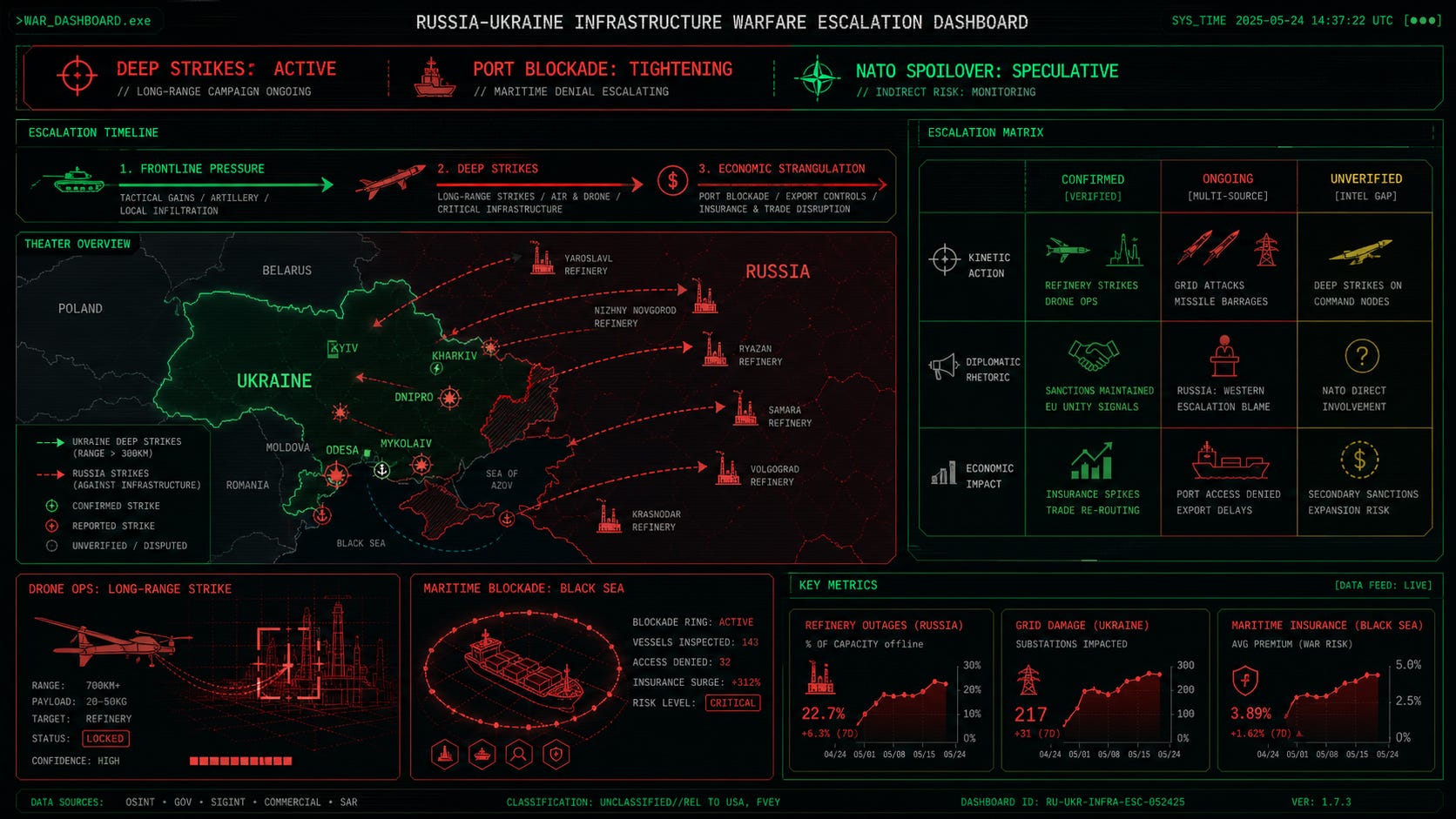
ARCHIVE #077 | TOPIC: Russia-Ukraine Infrastructure Warfare / Deep Strikes / Port Blockade / NATO Spillover Narratives | STATUS: KINETIC ESCALATION CONFIRMED — SPOILover SCENARIOS REMAIN SPECULATIVE | CONFIDENCE: HIGH (infrastructure targeting), MEDIUM (blockade effectiveness), LOW (imminent strikes on EU soil)
📡 THE SIGNAL
> BREAKING: The Russia-Ukraine conflict is
> increasingly defined by mutual infrastructure
> warfare, moving beyond the traditional frontline.
> UKRAINE’S POSTURE: Systematic long-range drone
> and missile campaign targeting Russian oil
> refineries and industrial nodes (the “second
> theater of war”).
> RUSSIA’S POSTURE: Intensified strikes on
> Ukrainian energy grids and a tightening
> de facto maritime blockade of Odesa and
> Danube river ports to choke logistics.
> NARRATIVE VS. REALITY: Speculative claims
> suggest Ukraine is being pushed to “irrational”
> self-destruction by allies, and that Russia may
> soon strike military-industrial targets in the
> EU (e.g., Germany). Open-source intelligence
> confirms the kinetic escalation, but finds NO
> verified evidence of imminent NATO spillover or
> definitive secret diplomatic tracks (e.g., Baku)
> dictating this trajectory.
The Russo-Ukrainian war has fundamentally shifted into a protracted infrastructure conflict. The battlefield is no longer confined to the contact line; it now spans hundreds of kilometers, targeting the economic and logistical lifeblood of both nations.
Ukraine has developed and deployed a systematic campaign of long-range unmanned aerial vehicles (UAVs) and missiles. Analysts increasingly refer to this as the “second theater of war,” focusing on Russian oil refineries, fuel depots, and industrial manufacturing nodes. The strategic goal is to degrade Russia’s war-fighting capacity and inflict long-term economic costs.
In response, Russia has escalated its own infrastructure campaign. This includes relentless strikes on Ukraine’s energy generation and distribution networks, causing severe disruptions to civilian and industrial services, as documented by international monitoring missions. Concurrently, Russia is executing a de facto maritime blockade of Ukrainian ports in Odesa and the Danube delta. This is designed to strangle Ukraine’s grain and metal exports and disrupt the maritime logistics chains that sustain its defense industry.
Alongside these kinetic realities, a layer of speculative narrative has emerged. Some commentators argue that Ukraine is being driven by Western allies to inflict maximum damage on Russia, even at the cost of Ukraine’s own existence as a socio-economic entity, rendering Kyiv “irrational” and unwilling to negotiate. Furthermore, rumors suggest that if progress stalls, Russia may cross the ultimate red line and strike military-industrial facilities within European Union territory (specifically mentioning Germany), citing unconfirmed “backchannel” meetings in locations like Baku.
Analytical assessment: While the infrastructure war is a verified, escalating reality, the narrative of imminent NATO spillover or Ukraine acting purely as a suicidal proxy lacks evidentiary support in open-source intelligence. Russia has historically shown a strong reluctance to strike NATO territory, calculating that the diplomatic and military fallout would outweigh the tactical benefits, especially if Moscow harbors any desire for post-conflict normalization with the West.
🔗 Sources: Re:Russia | Interfax | Rossiyskaya Gazeta | UN News
✅ WHAT’S CONFIRMED (FACTS)
→ Ukraine’s “Second Theater” campaign
Ukraine is conducting a sustained, systematic campaign of long-range strikes against Russian oil refining, energy, and industrial infrastructure. Analysts widely recognize this as a distinct, strategic theater of operations.
→ Russia’s infrastructure and energy targeting
Russia continues to intensify strikes on Ukrainian energy infrastructure. UN monitoring missions and independent analysts have documented severe, cumulative damage to Ukraine’s power grid and civilian services.
→ De facto maritime blockade
Russian military actions in the Black Sea, particularly targeting port infrastructure in Odesa and the Danube river delta, are widely assessed by military experts as an attempt to establish a functional maritime blockade to choke Ukrainian exports and military logistics.
⚠️ WHAT REQUIRES CONTEXT (NARRATIVE VS. REALITY)
> CAUTION: “IRRATIONAL PROXY” = POLITICAL NARRATIVE | “EU SPOILover” = SPECULATIVE FORECAST | “BAKU TALKS” = UNCONFIRMED RUMOR🔍 The “Irrational Proxy” narrative
The claim that Ukraine will fight to “complete humanitarian catastrophe” solely because Western allies demand maximum damage to Russia, rendering Kyiv “irrational,” is a political assessment, not a verified fact. While Western support is critical, framing Ukraine’s strategic decisions as purely dictated by external actors ignoring its own survival imperatives is an oversimplification of a complex geopolitical dynamic.
🔍 The specter of strikes on EU territory
Speculation that Russia will imminently strike military-industrial facilities in Germany or other EU nations remains unsubstantiated by open-source intelligence. Russia has consistently avoided direct kinetic engagement with NATO territory, calculating that the risk of triggering Article 5 or total Western economic decoupling outweighs the tactical value of such strikes. This restraint suggests a desire to keep a pathway open for post-conflict diplomatic relations with the West.
🔍 Unconfirmed diplomatic channels
Rumors of secret, high-level negotiations between Moscow and Berlin in Baku (or elsewhere) aimed at managing escalation lack credible, independent verification. While backchannel communications are a standard feature of international conflict, treating specific, unverified meetings as definitive proof of an impending strategic shift is analytically unsound.
🎯 STRATEGIC BREAKDOWN: 4 KEY DIMENSIONS
> INFRASTRUCTURE WARFARE DYNAMICS: DECODED1. THE ASYMMETRIC DEEP STRIKE
Ukraine’s ability to project force deep into Russian territory using relatively inexpensive drones forces Russia to disperse its air defense assets. This “second theater” degrades Russia’s fuel logistics and imposes a “war tax” on its domestic economy, proving that geographic depth no longer guarantees immunity.
2. ECONOMIC STRANGULATION VIA BLOCKADE
Russia’s targeting of the Danube and Odesa ports is a direct counter to Ukraine’s asymmetric successes. By threatening the maritime export routes, Russia aims to collapse Ukraine’s macroeconomic stability, increase the cost of Western financial support, and hinder the import of critical dual-use goods.
3. THE RED LINE OF NATO TERRITORY
The speculation about striking EU targets ignores the fundamental calculus of deterrence. Striking a NATO member state transforms a regional conflict into a potential global war. Unless Russia perceives an existential, immediate threat that cannot be neutralized within Ukraine, the threshold for crossing this red line remains exceptionally high.
4. THE POST-CONFLICT CALCULUS
Russia’s restraint regarding EU infrastructure may indeed be linked to long-term strategic planning. Even in a state of high tension, Moscow likely calculates that preserving the possibility of future energy or diplomatic relations with select European capitals is more valuable than the marginal gain of destroying a specific factory in Germany.
💬 CONCLUSION
The frontline has expanded.
Refineries burn. Ports are blockaded.
The grid flickers.
The infrastructure war is not a prediction.
It is the current reality.
The question isn’t whether the conflict is escalating.
It is.
The question is whether the rhetoric of “spillover”
and “irrational proxies” reflects actual strategy,
or merely the noise of information warfare
designed to provoke fear.
Russia strikes the grid.
Ukraine strikes the refineries.
Both seek economic strangulation.
Watch the ports.
Watch the power plants.
Watch the red lines —
and note how rarely they are actually crossed.
> ARCHIVE #077: LOGGED
> ACTION: TRACK KINETIC REALITY, NOT SPECULATIVE FEAR
#InfrastructureWarfare #DeepStrikes #BlackSeaBlockade #Geopolitics #EscalationManagement #ArchiveTheControlStack
→ archivethecontrolstack.substack.com
Archive The Control Stack — deconstructing signals in the age of information noise. Facts only. Clear structure. Minimal speculation.