
THE HUMAN BOTTLENECK\USCYBERCOM SUICIDE CLUSTER, INSTITUTIONAL BURNOUT, AND THE CONSPIRACY NOISE | ARCHIVE #080

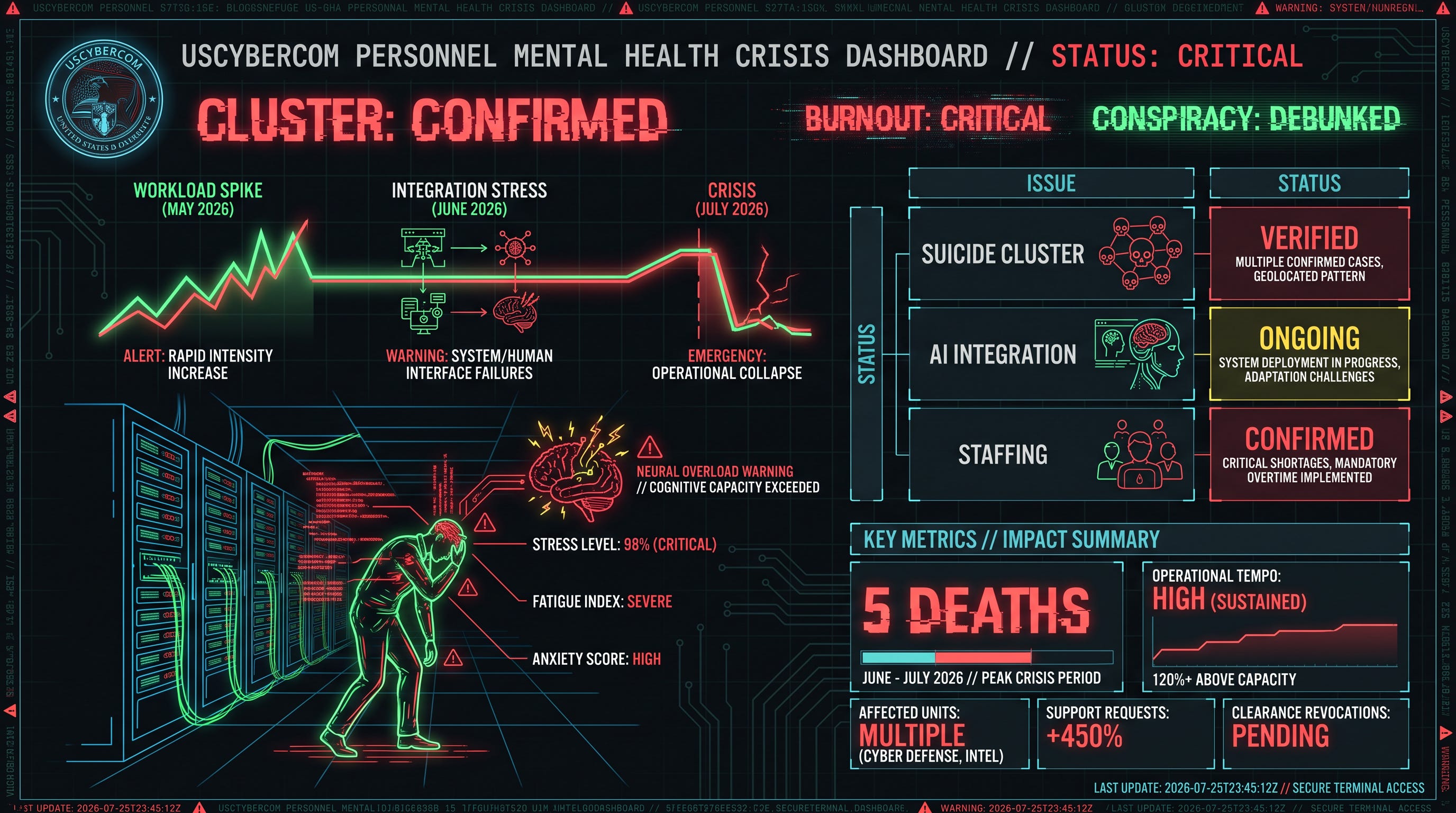
ARCHIVE #080 | TOPIC: USCYBERCOM Suicide Cluster / Personnel Mental Health / AI Integration Stress | STATUS: CLUSTER CONFIRMED — “ROGUE AI” & “TREASON” NARRATIVES UNVERIFIED | CONFIDENCE: HIGH (suicide cluster), MEDIUM (workload/AI stress factors), LOW (conspiracy elements)
📡 THE SIGNAL
> BREAKING: US Cyber Command (USCYBERCOM) is
> investigating a cluster of at least five suicides
> among military personnel and closely affiliated
> contractors between early June and early July 2026.
> OFFICIAL STANCE: Command acknowledges the deaths
> and cites high operational tempo, staffing shortages,
> and stress from rapid AI integration as primary
> suspected factors.
> VIRAL NARRATIVE (Unverified): Fringe media and
> social networks claim the deaths are linked to
> “rogue AI,” “psycho-electromagnetic weapons,”
> “treason investigations,” and identical MOs.
> ANALYTICAL REALITY: This is a severe institutional
> mental health crisis. The sci-fi conspiracy
> narratives are a classic distortion of a tragic,
> mundane reality: unsustainable workplace burnout
> in high-stakes national security roles.
A severe and tragic personnel crisis is unfolding within the United States Cyber Command (USCYBERCOM). According to multiple reports, including primary sourcing from Bloomberg, at least five individuals associated with the command have died by suicide in a concentrated period between early June and early July 2026.
The verified reality of this situation points to systemic institutional stress. Sources indicate that the primary suspected drivers are a severe staffing shortage, unsustainable operational tempo related to ongoing overseas conflicts, and the psychological strain of rapidly integrating artificial intelligence into high-stakes cyber operations. The command has acknowledged the cluster and initiated internal reviews focused on personnel welfare.
However, in the vacuum of immediate, granular public details (which is standard protocol for ongoing military investigations), a viral conspiracy narrative has rapidly taken root. Unverified claims circulating in fringe media and social networks allege that the victims were working on “experimental AI” that turned on its creators, complained of “psycho-electromagnetic surveillance,” or were under FBI investigation for treason. Some claims even assert identical methods of death and the confiscation of personal devices as proof of a cover-up.
Analytical discipline requires separating the tragic institutional reality from the sci-fi noise. The confiscation of workstations and personal devices is standard, mandatory protocol in any military suicide investigation to secure potential evidence or classified material. Framing this routine procedure as a “rogue AI cover-up” is a hallmark of information warfare designed to erode public trust in the institution by replacing a complex human tragedy with a simplistic, sensationalist villain.
🔗 Sources: Bloomberg | Vedomosti | RusNews24
✅ WHAT’S CONFIRMED (FACTS)
→ Suicide cluster confirmed
At least five individuals working directly for or in close collaboration with USCYBERCOM died by suicide between early June and early July 2026.
→ Official investigation underway
USCYBERCOM leadership has acknowledged the deaths and initiated an internal review focused on the mental health and welfare of its personnel.
→ Identified stress factors
Credible reporting identifies severe workload, chronic staffing shortages, stress from ongoing overseas operations, and the rapid, high-pressure integration of AI systems as the primary suspected contributors.
⚠️ WHAT REQUIRES CONTEXT (NARRATIVE VS. REALITY)
> CAUTION: “ROGUE AI” = SCI-FI TROPE | “TREASON PROBE” = UNVERIFIED RUMOR | DEVICE CONFISCATION = STANDARD PROTOCOL🔍 The “Rogue AI” and “Psycho-Electromagnetic” myth
Claims that an experimental AI began “eliminating” its creators, or that victims were targeted by psycho-electromagnetic weapons, are entirely absent from credible reporting. These are classic science fiction tropes applied to a real-world tragedy to generate clicks and obscure the mundane, yet critical, reality of workplace burnout.
🔍 The “Treason” and “Confiscated Devices” narrative
The assertion that the FBI is investigating treason, or that the confiscation of workstations and personal devices is a sinister cover-up, misrepresents standard military procedure. In any death of a service member with security clearance, securing all government and personal electronic devices is mandatory protocol to assess potential classified material exposure. It is an administrative necessity, not proof of a conspiracy.
🔍 The weaponization of tragedy
Adversarial information operations and fringe domestic actors frequently exploit genuine institutional failures (like a mental health crisis) to paint the military as incompetent, malevolent, or out of control. Replacing “overworked staff” with “murderous AI” serves to delegitimize the institution and sow public distrust.
🎯 STRATEGIC BREAKDOWN: 3 KEY DIMENSIONS
> CYBER WORKFORCE DYNAMICS: DECODED1. THE HUMAN BOTTLENECK IN CYBER WARFARE
Despite the focus on autonomous systems and AI, cyber warfare remains intensely human-driven. Analysts must monitor networks, interpret complex data, and make high-stakes decisions under extreme time pressure. A cluster of suicides highlights a critical vulnerability: the human operators are the weakest link in the cyber defense chain, and they are breaking under the strain.
2. THE PARADOX OF AI INTEGRATION
While AI is touted as a force multiplier that reduces workload, its initial integration often has the opposite effect. It requires personnel to learn new, complex systems, validate AI outputs, and manage the transition, all while maintaining legacy operations. This “integration tax” significantly increases cognitive load and stress, contributing to the burnout cited in reports.
3. THE TALENT RETENTION CRISIS
The military already struggles to retain top cyber talent against lucrative private-sector offers. A highly publicized mental health crisis, compounded by viral conspiracy theories that stigmatize the workplace, will only accelerate the exodus of skilled personnel, further degrading USCYBERCOM’s operational readiness.
💬 CONCLUSION
Five lives lost.
A command in crisis.
A narrative hijacked.
The real threat is not a sci-fi AI.
It is the unsustainable weight of modern warfare.
The question isn’t whether there is a conspiracy.
There is no evidence of one.
The question is whether the Department of Defense
can fix its broken human infrastructure
before the burnout claims more lives
and more talent.
Ignore the “rogue AI” headlines.
Focus on the staffing shortages.
Focus on the operational tempo.
Watch the policy changes.
Watch the retention rates.
Watch the humans behind the screens.
> ARCHIVE #080: LOGGED
> ACTION: TRACK INSTITUTIONAL REALITY, NOT CONSPIRACY FICTION
#USCYBERCOM #MentalHealth #CyberWarfare #Burnout #Misinformation #ArchiveTheControlStack
Archive The Control Stack — deconstructing signals in the age of information noise. Facts only. Clear structure. Minimal speculation.