
ARCHIVE #076: THE WATER WEAPON PERSIAN GULF'S DESALINATION VULNERABILITY IN THE IRAN CONFLICT

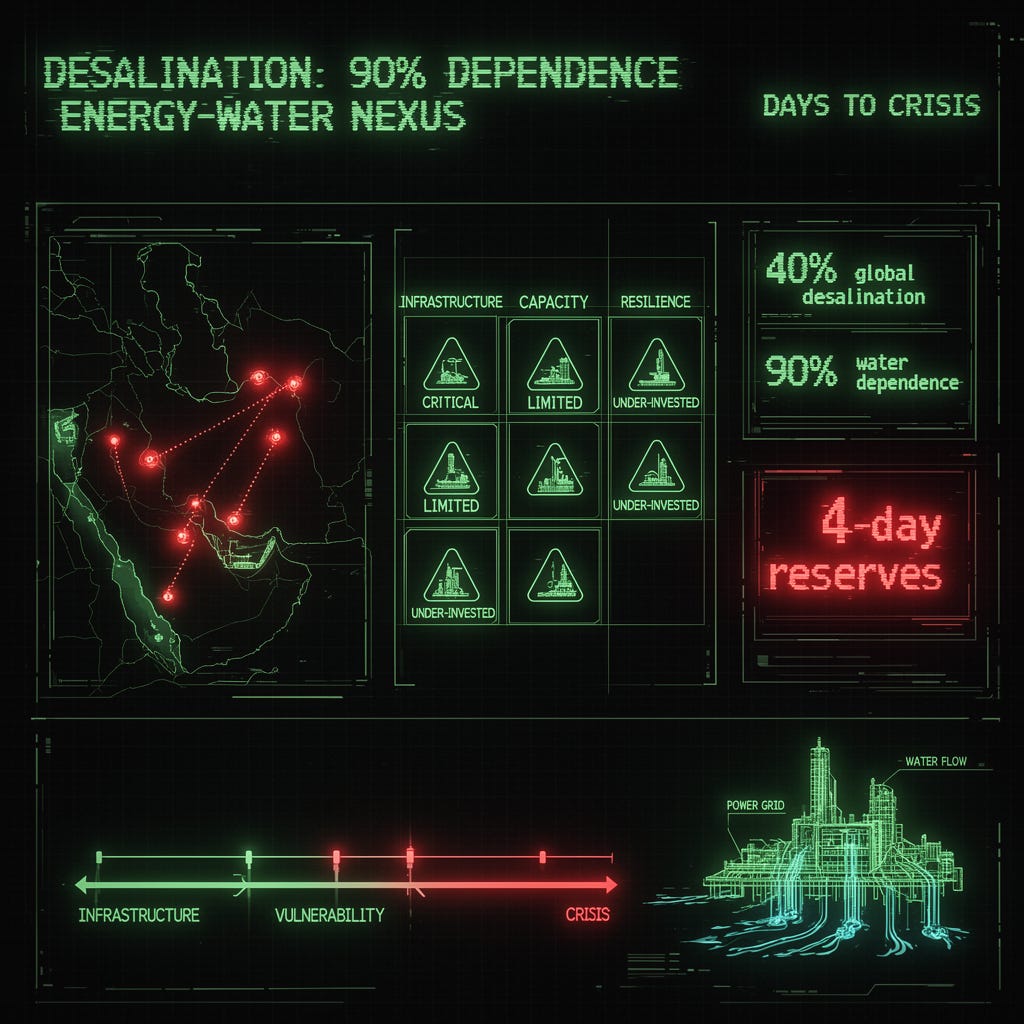
ARCHIVE #076 | TOPIC: Persian Gulf Desalination Vulnerability / Water as Strategic Weakness / Iran Conflict Impact | STATUS: VULNERABILITY CONFIRMED — CRISIS POTENTIAL INCREASED | CONFIDENCE: HIGH (desalination dependence), MEDIUM (attack impacts), LOW (exact crisis timeline)
📡 THE SIGNAL
> BREAKING: Iran conflict exposes Persian Gulf
> states’ strategic vulnerability: 40-99% of
> freshwater comes from desalination, which
> depends on energy infrastructure.
> CONFIRMED IMPACTS: Iran claims attack on
> Qeshm desalination plant; Bahrain reports
> drone strike on desalination facility; Kuwait
> reports fires at Doha-West energy complex
> (integrated with desalination).
> STRATEGIC RISK: Most desalination plants
> are integrated with power generation. Attacks
> on energy infrastructure automatically disrupt
> water supply without direct strikes on
> desalination equipment.
> HUMANITARIAN THRESHOLD: Water reserves in
> major cities (Riyadh, Dubai, Doha) may last
> only days before crisis escalates to evacuation
> scenarios.
> HISTORICAL PRECEDENT: 1990-91 Gulf War saw
> Iraq attack Kuwaiti desalination plants.
The Iran conflict has revealed a critical vulnerability in the Persian Gulf region: water security. While the region is often associated with oil wealth, the true Achilles’ heel is its dependence on desalinated water for survival. The Persian Gulf is one of the world’s most water-stressed regions, with minimal natural freshwater resources to support growing populations, industry, and agriculture.
The solution for Gulf states has been to leverage their energy resources to power massive desalination operations. This has enabled the transformation of deserts into global business and tourism hubs with skyscrapers, golf courses, indoor ski resorts, and data centers. However, this solution has created a strategic vulnerability: approximately 40-99% of freshwater in Gulf states comes from desalination, with Kuwait, Bahrain, and Qatar being particularly dependent (90-99%).
The current conflict has exposed this vulnerability. Iran has claimed to have struck the desalination plant on Qeshm Island. Bahrain has reported a drone attack on one of its desalination facilities. In Kuwait, debris from an intercepted missile caused fires at the Doha-West energy complex, which is integrated with desalination infrastructure. The Strategic risk is clear: most desalination plants are integrated with power generation. An attack on energy infrastructure automatically disrupts water supply without requiring direct strikes on desalination equipment.
The humanitarian threshold is alarmingly low. In major cities like Riyadh, Dubai, and Doha, water reserves may last only days before crisis escalates to evacuation scenarios. This creates a domino effect: first industrial and business restrictions, then water rationing for citizens, followed by airport and hotel closures, and potentially healthcare system collapse.
While Gulf states are investing in strategic water reserves and more efficient desalination technology, most reserves are designed to last only days, and recovery from damaged desalination plants could take years. This vulnerability is not new—during the 1990-91 Gulf War, Iraq targeted Kuwaiti desalination plants, forcing Kuwait to rely on emergency water shipments from Saudi Arabia and Turkey.
🔗 Sources: IAREX | Vfokuse | Zapoved | 24.kz
✅ WHAT’S CONFIRMED (FACTS)
→ Gulf states’ desalination dependence
Persian Gulf countries produce ~40% of global desalinated water. Kuwait (90%), Oman (86-90%), Saudi Arabia (70%), UAE (40-42%), Bahrain (85-90%), and Qatar (up to 99%) rely heavily on desalination for freshwater.
→ Iran’s infrastructure targeting
Iran claims strike on Qeshm desalination plant; Bahrain reports drone attack on desalination facility; Kuwait reports fires at Doha-West energy complex (integrated with desalination).
→ Integrated energy-water infrastructure
Most desalination plants are integrated with power generation. Attacks on energy infrastructure automatically disrupt water supply without direct strikes on desalination equipment.
→ Historical precedent
During 1990-91 Gulf War, Iraq attacked Kuwaiti desalination plants and dumped crude oil into the Persian Gulf, forcing Kuwait to rely on emergency water shipments from Saudi Arabia and Turkey.
⚠️ WHAT REQUIRES CONTEXT
> CAUTION: “DAYS TO EVACUATION” = ESTIMATED THRESHOLD | “99% DEPENDENCE” = PEAK SCENARIO | “WATER AS PRIMARY STRATEGIC WEAKNESS” = ANALYTICAL FRAMEWORK🔍 “Days to evacuation” is an estimated threshold
The claim that major cities have “only days before evacuation” is an analytical estimate based on current water reserves. Actual timelines vary by city, infrastructure, and emergency response. While reserves are limited, emergency measures could extend the timeframe. The key point is that water reserves are measured in days, not weeks or months.
🔍 “99% dependence” is a peak scenario
The 99% figure for Qatar represents a worst-case scenario for major urban centers. National averages are lower, but critical infrastructure (hospitals, airports, data centers) is heavily dependent on desalination. The vulnerability is real, but not uniform across all sectors and regions.
🔍 “Water as primary strategic weakness” is an analytical framework
The framing that water is the “primary strategic weakness” rather than oil is an analytical perspective. While water security is critical, oil remains the economic foundation of Gulf states. This framework highlights how vulnerabilities are evolving with changing technology and infrastructure dependencies.
🎯 STRATEGIC BREAKDOWN: 5 KEY DIMENSIONS
> DESALINATION VULNERABILITY DYNAMICS: DECODED1. THE ENERGY-WATER NEXUS
The critical vulnerability is not desalination itself, but the integration of desalination with power generation. Most plants are co-located with power facilities, sharing infrastructure and energy sources. This creates a single point of failure: an attack on energy infrastructure automatically disrupts water supply. The vulnerability is not “water vs. energy” but “water AND energy” as a single target.
2. THE HUMANITARIAN DOMINO EFFECT
A water crisis triggers a cascade of failures: first industrial restrictions, then water rationing, followed by airport and hotel closures, and eventually healthcare system collapse. The timeline from energy disruption to humanitarian crisis is measured in days, not weeks. This compressed timeline creates a narrow window for crisis response.
3. THE HISTORICAL PRECEDENT
The 1990-91 Gulf War provides a template: Iraq attacked Kuwaiti desalination plants, forcing Kuwait to rely on emergency water shipments. Today’s vulnerability is similar but more acute—population growth, urbanization, and infrastructure complexity have increased water dependence while emergency response capabilities remain limited.
4. THE INVESTMENT GAP
Gulf states are investing in strategic water reserves, more efficient desalination technology, and wastewater reuse. However, most reserves are designed to last only days, and recovery from damaged desalination plants could take years. The gap between investment and vulnerability remains significant, especially for critical infrastructure.
5. THE GEOPOLITICAL SHIFT
Water security is redefining strategic priorities in the Gulf. While oil remains the economic foundation, water is becoming the primary strategic vulnerability. This shift is altering military planning, diplomatic priorities, and infrastructure investments. The region is no longer “oil-rich but water-poor”—it’s “water-dependent with oil wealth.”
💬 CONCLUSION
Oil wealth built the Gulf.
Desalination sustains it.
Energy powers both.
The vulnerability is not water.
The vulnerability is the link.
The question isn’t whether the Gulf has water.
It does.
The question is whether it can keep the
energy flowing to make it.
When the power goes out,
the water disappears.
The 1990s taught us this lesson.
The current conflict reminds us.
Watch the power lines.
Watch the water reserves.
Watch for the first signs
of rationing.
The water crisis
will arrive before
the oil runs dry.
> ARCHIVE #076: LOGGED
> ACTION: TRACK INFRASTRUCTURE LINKAGES, NOT JUST SINGLE POINTS
#PersianGulf #Desalination #WaterSecurity #IranConflict #EnergyInfrastructure #ArchiveTheControlStack
→ archivethecontrolstack.substack.com
Archive The Control Stack — deconstructing signals in the age of information noise. Facts only. Clear structure. Minimal speculation.