
ARCHIVE #074: THE SACCADIC BLIND SPOT NORTHWESTERN UNIVERSITY'S "PHANTOM TWIST" AND THE RISE OF PERCEPTUAL CAMOUFLAGE

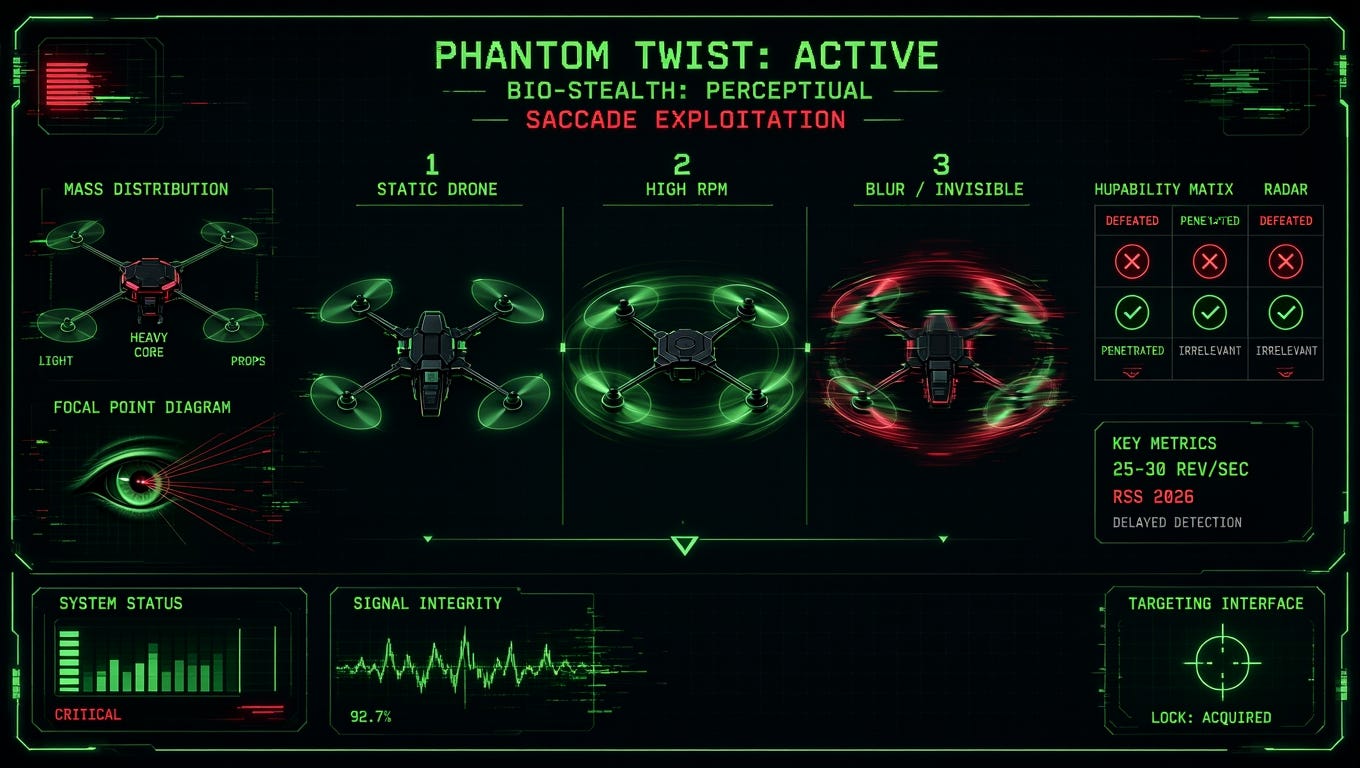
ARCHIVE #074 | TOPIC: Northwestern University “Phantom Twist” / Perceptual Camouflage / Bio-Stealth UAV | STATUS: RESEARCH PRESENTED (RSS 2026) — CONCEPT VALIDATION PHASE | CONFIDENCE: HIGH (academic presentation), MEDIUM (lab detection delays), LOW (field-deployed saccade tracking)
📡 THE SIGNAL
> BREAKING: Northwestern University researchers
> presented “Phantom Twist” at Robotics: Science
> and Systems (RSS) 2026 in Sydney.
> CONCEPT: “Perceptual camouflage” or “bio-stealth.”
> MECHANISM: High-speed rotation (approx. 25-30 rev/sec)
> combined with specific mass distribution and
> translucent materials.
> TARGET: Exploits human visual persistence and
> saccadic masking to render the drone as a
> blurry, indistinct disc, delaying human detection.
> SHIFT: Moves away from traditional stealth
> (radar/thermal) to target the biological sensor:
> the human observer.
Engineers at Northwestern University, led by Associate Professor Michael Rubenstein, have introduced a radical shift in unmanned aerial vehicle (UAV) design. Presented at the Robotics: Science and Systems (RSS) 2026 conference in Sydney, the project, dubbed “Phantom Twist,” does not rely on radar-absorbing materials, thermal masking, or transparent panels. Instead, it weaponizes the biological limitations of human vision.
The core mechanism is high-speed rotation. By spinning the entire airframe at speeds approaching 25–30 revolutions per second, the drone exploits visual persistence (the eye’s inability to process continuous high-framerate data) and saccadic masking (the brain’s temporary suppression of visual processing during rapid eye movements).
To the human observer, the drone does not appear as a distinct quadcopter with four blades. Instead, it manifests as a faint, semi-transparent, blurry disc that blends into the background, easily mistaken for a lens artifact, dust, or a trick of the light.
The engineering achievement lies not just in the speed, but in the mass distribution. Heavy components (battery, flight controller) are concentrated strictly on the central axis of rotation, while lightweight, translucent, micro-porous propellers are extended outward. This mimics a figure skater pulling in their arms, ensuring aerodynamic stability and preventing structural failure under extreme centrifugal forces.
Most provocatively, the research explores psycho-physical exploitation. Theoretical frameworks within the project suggest using onboard micro-sensors to detect observer proximity and introduce micro-oscillations that sync with natural human saccades, hiding the drone’s silhouette during the milliseconds the brain is “blind” to motion.
This represents a paradigm shift: bio-stealth. Instead of hiding from machines (radar, lidar), the drone is designed to hack the ultimate legacy sensor: the human nervous system.
🔗 Sources: RSS 2026 Proceedings | Northwestern University | Sociable (Contextual Tech Analysis)
✅ WHAT’S CONFIRMED (FACTS)
→ RSS 2026 Presentation confirmed
Northwestern University researchers (led by M. Rubenstein) presented a paper on computationally designed low-observability UAVs using human-perception-aligned metrics at the RSS 2026 conference in Sydney.
→ Perceptual camouflage mechanism
The drone utilizes high-speed whole-body rotation to exploit visual persistence, rendering the airframe as a blurred, semi-transparent disc rather than a distinct object.
→ Specialized mass distribution
Design features centralized heavy components (on the axis of rotation) and lightweight, translucent propellers to maintain structural integrity and aerodynamic stability at high RPM.
→ Delayed human detection in lab settings
Controlled experiments demonstrated that human subjects take significantly longer to identify the rotating drone against complex backgrounds compared to a standard hovering quadcopter, often misidentifying it as a visual artifact.
⚠️ WHAT REQUIRES CONTEXT (ANALYTICAL EXTRAPOLATION)
> CAUTION: LAB METRICS ≠ FIELD REALITY | SACCADE TRACKING = THEORETICAL/EARLY STAGE | NOT TRUE INVISIBILITY🔍 Specific metrics (25-30 rev/sec, 12s vs 1.5s detection)
While the principle of high-speed rotation is confirmed, specific figures like “exactly 25 rev/sec” or “12 seconds vs 1.5 seconds detection time” are likely illustrative of the lab environment or conceptual limits. Real-world detection times vary wildly based on lighting, background contrast, and observer training.
🔍 Real-time saccade synchronization
The concept of the drone using lidar to track a human’s eye movements and syncing its micro-oscillations to saccadic masking is a psycho-physical hypothesis or early-stage research direction. It is not a fully realized, reliable field capability. It represents the cutting edge of the theoretical framework, not a deployed tactical feature.
🔍 The onboard camera limitation
A spinning drone cannot easily capture stable video. The text notes that digital stabilization with temporal shifting is currently limited to very short (e.g., 5-second) bursts. Therefore, this is not a loitering surveillance platform, but a tactical infiltration tool designed to cross a danger zone quickly, then stop spinning to observe.
🎯 STRATEGIC BREAKDOWN: 4 KEY DIMENSIONS
> PERCEPTUAL CAMOUFLAGE DYNAMICS: DECODED1. THE PARADIGM SHIFT: BIO-STEALTH OVER RADAR STEALTH
Traditional stealth focuses on defeating machines (reducing Radar Cross Section, suppressing infrared signatures). Phantom Twist acknowledges a tactical reality: in many scenarios (urban infiltration, perimeter breach), the human observer (a guard, a sniper, a civilian) is the final decision-making sensor. If the human brain cannot process the visual data, the machine detection becomes secondary. It hacks biology, not physics.
2. WEAPONIZING SACCADES AND PERSISTENCE
Human vision is not a continuous video stream; it is a series of snapshots stitched together by the brain. By rotating faster than the brain’s “frame rate” and exploiting the milliseconds of blindness during saccades (rapid eye movements), the drone creates a cognitive blind spot. The observer’s brain literally discards the data as noise or an artifact.
3. TACTICAL INFILTRATION, NOT LOITERING
Due to the physical limitations of spinning (centrifugal stress, camera stabilization challenges), this platform is not designed for hours of overhead surveillance. Its optimal use case is rapid, low-observability transit. It spins to cross an open, guarded gap invisibly, then halts rotation to hover quietly and observe from cover. It is a breaching tool, not a sentinel.
4. THE FUTURE FRONTIER: FOOLING COMPUTER VISION
The researchers note future iterations may incorporate chaotic tumbling. This is critical: if high-speed rotation can fool the human eye, can it also fool AI object detection models (like YOLO) that are trained primarily on static, clearly defined images of drones? Perceptual camouflage may evolve into algorithmic camouflage, defeating both biological and artificial sensors simultaneously.
💬 CONCLUSION
Not hidden by paint.
Not hidden by shape.
Hidden by speed.
The drone does not vanish.
The observer’s brain simply refuses to see it.
The question isn’t whether the technology is real.
It is.
The question is how warfare changes
when the enemy is no longer a physical object,
but a glitch in your own perception.
We are not hiding the machine.
We are hacking the observer.
Watch the research.
Watch the AI benchmarks.
Watch the moment the blur
becomes the standard.
> ARCHIVE #074: LOGGED
> ACTION: TRACK THE BIOLOGICAL EXPLOIT, NOT JUST THE HARDWARE
#PhantomTwist #BioStealth #PerceptualCamouflage #NorthwesternUniversity #RSS2026 #DroneTech #ArchiveTheControlStack
→ archivethecontrolstack.substack.com
Archive The Control Stack — deconstructing signals in the age of information noise. Facts only. Clear structure. Minimal speculation.