
ARCHIVE #073: THE CHOKEPOINT STRATEGY IRAN'S ASYMMETRIC PLAYBOOK FOR HORMUZ, BAB-EL-MANDEB, AND THE GLOBAL LOGISTICS SHOCK

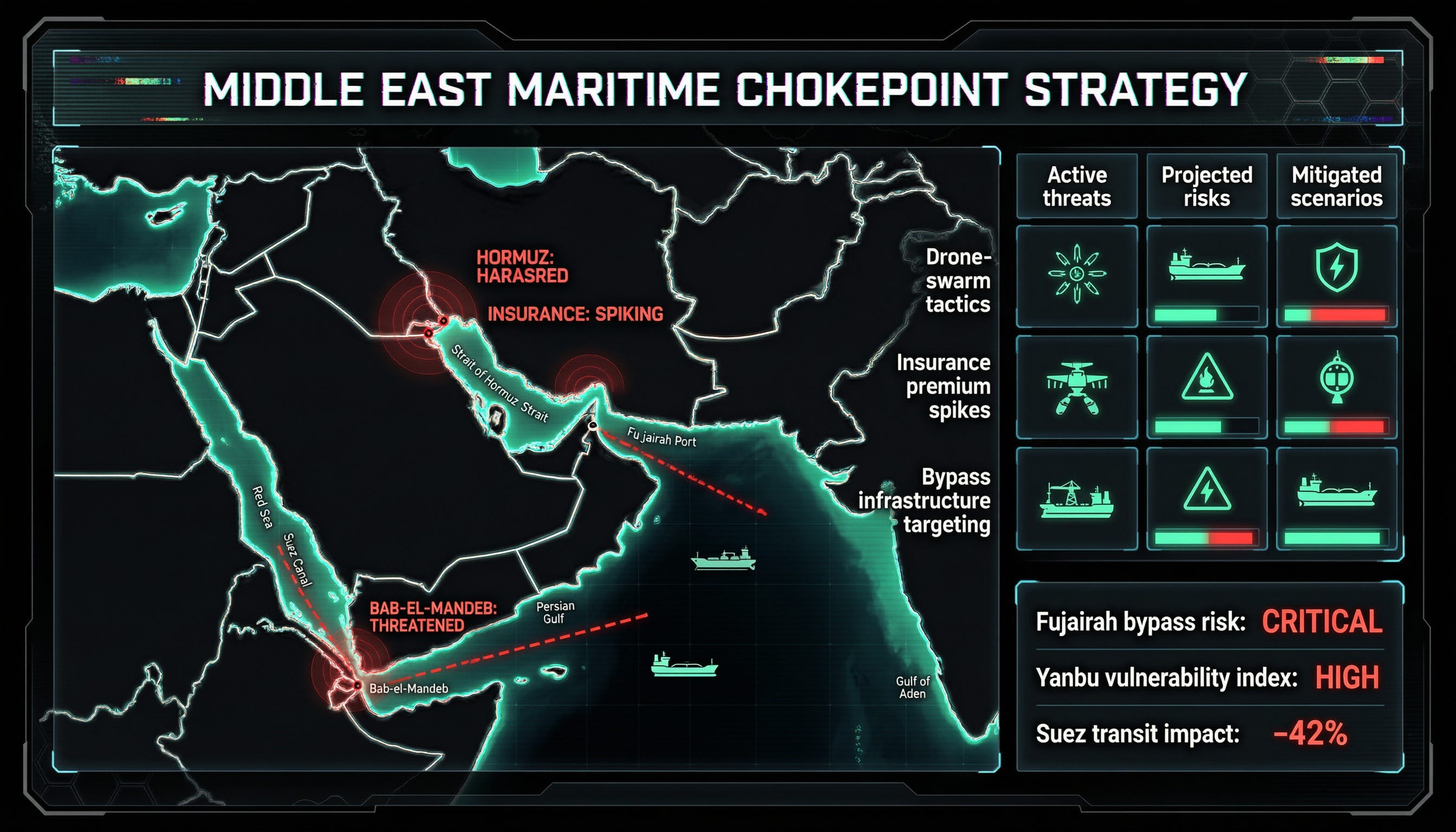
ARCHIVE #073 | TOPIC: Middle East Escalation / Iranian Asymmetric Maritime Strategy / Hormuz & Bab-el-Mandeb Chokepoints | STATUS: ESCALATION ACTIVE — SPECIFIC TANKER STRIKE CLAIMS UNVERIFIED | CONFIDENCE: HIGH (asymmetric doctrine), MEDIUM (maritime incidents), LOW (total blockade scenario)
📡 THE SIGNAL
> BREAKING: Escalation in Middle East maritime
> theater. US and Iran exchanging strikes.
> REPORTED CLAIMS (Unverified): Tankers departing
> Fujairah struck by anti-ship missiles; US
> destroyers failed to intercept; casualties reported.
> HOUTHI ACTION: Retaliatory strikes on Riyadh
> airport/airbase in response to Saudi strikes on Sana’a.
> STRATEGIC THESIS: Iran + Houthi axis targeting
> maritime chokepoints (Hormuz, Bab-el-Mandeb) and
> bypass infrastructure (Fujairah, Yanbu).
> CORE DOCTRINE: Not necessarily a formal “blockade,”
> but systemic disruption to make insurance and
> logistics costs prohibitively high, effectively
> strangling oil exports without total physical closure.
As the US-Iran conflict expands, the maritime domain has become the primary theater of asymmetric warfare. Reports indicate a significant escalation involving Iranian IRGC forces and their Houthi allies in Yemen, targeting the critical maritime arteries that sustain the global economy.
The most alarming unverified claims circulating suggest that tankers departing the UAE’s Fujairah port were struck by anti-ship missiles, resulting in fires, casualties, and an alleged failure of US destroyer escorts to intercept the threats. While maritime incidents in this region are a documented pattern, this specific narrative of dual tanker destruction with casualties lacks independent confirmation and must be treated with analytical caution.
Concurrently, Houthi forces have demonstrated the capability and intent to project power beyond Yemen, launching retaliatory strikes against Saudi Arabian infrastructure, including airports and airbases in Riyadh, in response to Saudi aerial operations in Sana’a.
The strategic logic behind this escalation is clear and highly plausible, even if specific incident details are fogged by wartime information operations. Iran’s optimal strategy is not necessarily a formal, declared “blockade” of the Strait of Hormuz—which would invite overwhelming conventional military response—but rather a campaign of asymmetric attrition. By targeting the Fujairah bypass (which allows the UAE to export oil outside the Strait) and leveraging the Houthis to threaten Bab-el-Mandeb and the Saudi port of Yanbu, Iran can systematically drive up war risk insurance premiums and logistical costs.
The goal is not to sink every ship, but to make the perception of risk so high that global shipping companies voluntarily reroute or halt operations, achieving a de facto blockade through economic and psychological pressure, while dragging regional economies (like Egypt’s Suez Canal revenues) into the collateral damage.
🔗 Sources: Reuters | NY Times | IRIS France | Chosun Biz
✅ WHAT’S CONFIRMED (FACTS)
→ Maritime incidents near Hormuz/Fujairah are a documented pattern
Attacks on tankers and maritime infrastructure in the Gulf of Oman and near Fujairah have been repeatedly documented by UKMTO and international media. The threat is real and active.
→ Houthi capability to strike Saudi infrastructure
Houthi forces possess the missile and drone capabilities to strike deep into Saudi Arabia, including airports and critical infrastructure, as historically demonstrated and recently reiterated.
→ Iran’s asymmetric maritime doctrine
Iran’s military doctrine explicitly relies on asymmetric warfare, proxy networks (like the Houthis), and the threat to maritime chokepoints to offset US conventional superiority.
→ Vulnerability of bypass routes
Strategic analyses confirm that Iran views the UAE’s Fujairah port and Saudi Arabia’s Yanbu port as critical vulnerabilities in the event of a Hormuz closure, making them logical targets for disruption.
❌ WHAT’S UNVERIFIED (THE FOG OF WAR)
→ Specific claim: Two tankers destroyed with casualties near Fujairah
The narrative that two specific tankers were hit by anti-ship missiles, resulting in deaths, while US destroyers failed to intercept, is not confirmed by independent maritime security sources (like UKMTO or major shipping insurers). Treat as unverified wartime reporting.
→ Formal “closure” of the Strait of Hormuz
Claims that Iran has “already closed” the Strait are exaggerated. The reality is a heightened risk environment and sporadic incidents, not a formal, total physical blockade, which would be an act of war inviting immediate massive retaliation.
→ Complete shutdown of Yanbu and the Suez Canal
While these are prime targets for harassment, a total, prolonged shutdown of Yanbu’s 5M bpd capacity or the Suez Canal is a worst-case scenario. It depends on sustained Houthi capability, which faces ongoing degradation from US/UK airstrikes, and the robust response of Saudi air defenses.
🎯 STRATEGIC BREAKDOWN: 5 KEY DIMENSIONS
> ASYMMETRIC MARITIME DENIAL: DECODED1. THE INSURANCE WEAPON — PERCEPTION OVER DESTRUCTION
Iran does not need to sink a fleet to win. The true target is Lloyd’s of London and global maritime insurers. A few high-profile incidents, or even credible threats, cause war risk premiums to spike. When insurance costs exceed profit margins, shipping companies voluntarily halt transit. Iran achieves a de facto blockade through economic psychology, without firing a shot at every ship.
2. NEUTRALIZING THE FUJAIRAH BYPASS
The UAE built the Habshan-Fujairah pipeline specifically to bypass the Strait of Hormuz. By extending attacks to Fujairah, Iran signals that there is no safe bypass. If the alternative route is also contested, the strategic value of the Hormuz threat is magnified, trapping regional exporters in a dilemma.
3. THE HOUTHI MULTIPLIER — TWO FRONTS, ONE STRATEGY
The Houthis are not just a local Yemeni faction; they are Iran’s force multiplier in the Red Sea. By threatening Bab-el-Mandeb, they endanger the Suez Canal. This achieves two goals: it pressures Saudi Arabia directly, and it inflicts collateral economic damage on Egypt (a key Saudi ally) by starving the Suez Canal of transit fees, fracturing regional alliances.
4. THE US NAVY’S ATTRITION DILEMMA
Defending every tanker with a $2 billion guided-missile destroyer against $20,000 drones or anti-ship missiles is an unsustainable cost-exchange ratio. The US Navy cannot be everywhere at once. Iran’s strategy is designed to stretch US defensive capabilities to the breaking point, creating inevitable gaps in the defensive umbrella.
5. THE SUPER-TANKER BOTTLENECK
Even if oil is rerouted through the Suez Canal, logistical physics become a weapon. Ultra-Large Crude Carriers (ULCCs) carrying 2M+ barrels cannot fit through the Suez Canal. They must offload to smaller vessels or use alternative, longer routes (like around Africa), drastically reducing global shipping capacity and driving up freight rates, compounding the oil price shock.
💬 CONCLUSION
Two chokepoints.
One asymmetric strategy.
Iran does not need to close the Strait.
It only needs to make it too expensive to sail.
The question isn’t whether the US can defend every ship.
It cannot.
The question is whether global markets will price in
the risk of the next strike,
and voluntarily halt the flow of oil,
achieving Iran’s goal without a formal declaration of war.
The Houthis are the multiplier.
Fujairah is the bypass trap.
Insurance premiums are the real weapon.
Watch the premiums.
Watch the straits.
Watch the empty tankers.
> ARCHIVE #073: LOGGED
> ACTION: TRACK ECONOMIC IMPACT, NOT JUST KINETIC CLAIMS
#MiddleEastEscalation #StraitOfHormuz #BabElMandeb #AsymmetricWarfare #MaritimeSecurity #ArchiveTheControlStack
→ archivethecontrolstack.substack.com
Archive The Control Stack — deconstructing signals in the age of information noise. Facts only. Clear structure. Minimal speculation.