
ARCHIVE #072: THE 48-HOUR CHOKEPOINT WASHINGTON'S HORMUZ ULTIMATUM — FREE NAVIGATION OR "SERIOUS CONSEQUENCES" AS STRIKES ESCALATE

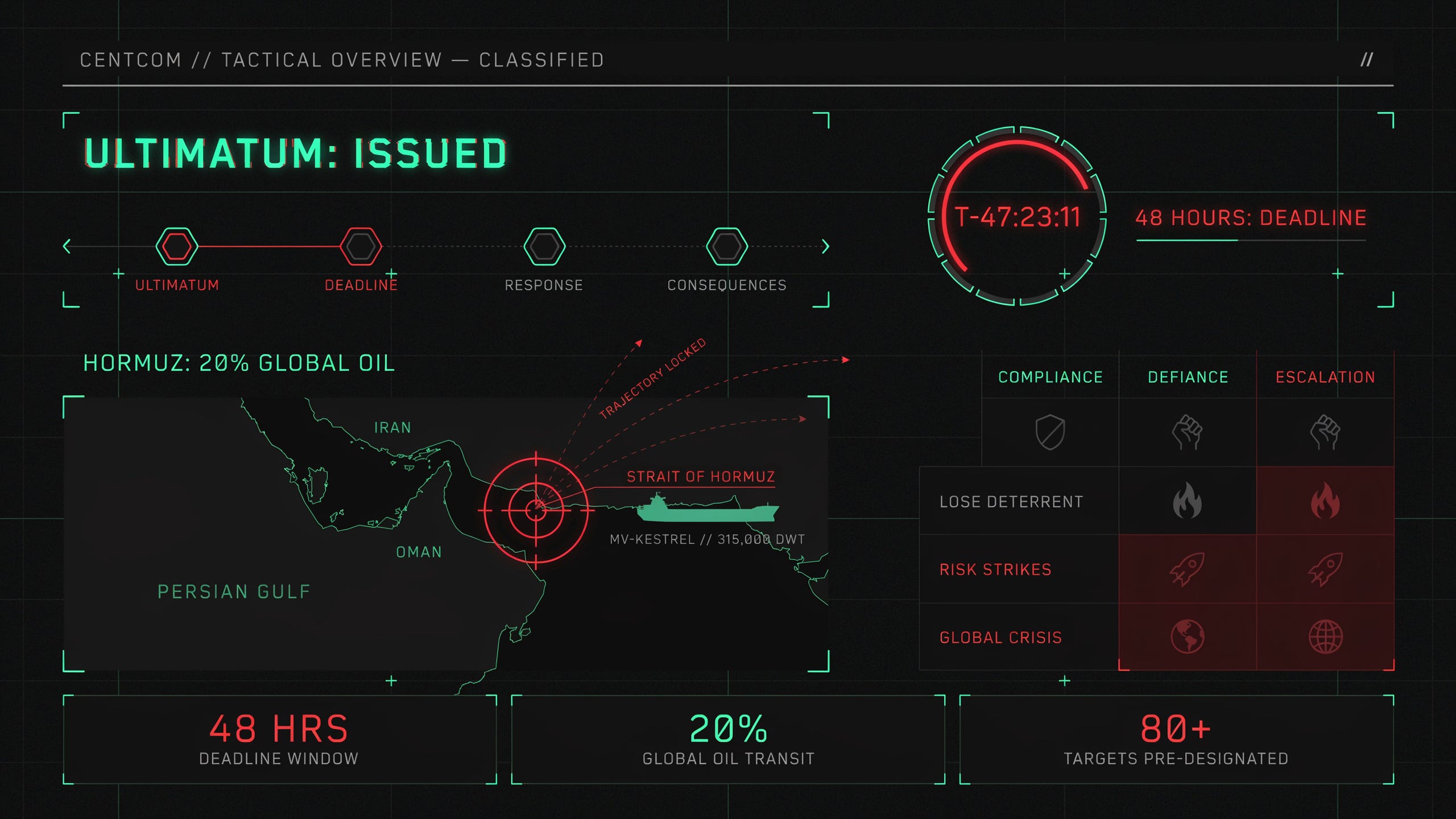
ARCHIVE #072 | TOPIC: US Ultimatum to Iran / Strait of Hormuz / 48-Hour Deadline / Freedom of Navigation | STATUS: ULTIMATUM ISSUED — DEADLINE ACTIVE | CONFIDENCE: HIGH (ultimatum confirmed), MEDIUM (48-hour timeline), LOW (contingency plan details)
📡 THE SIGNAL
> BREAKING: Israeli and Emirati media report
> Washington issued ultimatum to Tehran:
> publicly commit to ceasing attacks on
> civilian vessels and ensuring free
> navigation in Strait of Hormuz.
> TIMELINE: 48 hours (not 24 as some
> reports claimed). Deadline to comply.
> WARNING: “Serious consequences” if
> ultimatum not met.
> CONTEXT: Follows mutual US-Iran strikes
> (CENTCOM 80+ targets in Iran, IRGC
> claims on Gulf bases). Hormuz shipping
> contracted, oil prices rising.
> CONTINGENCY: Reports suggest military
> action plan “on the table” if diplomacy
> fails — not officially confirmed as
> formal operational order.
> PRECISION REQUIRED: 48 hours (not 24),
> “serious consequences” (not specific
> military action), contingency planning
> (not confirmed execution).
Israeli and Emirati media are reporting that Washington has issued a direct ultimatum to Tehran: publicly commit to ceasing attacks on civilian vessels and ensuring free navigation through the Strait of Hormuz. The reported deadline: 48 hours — not 24 hours as some early reports suggested.
The warning accompanying the ultimatum: failure to comply will result in “serious consequences.” Multiple sources indicate that a contingency action plan is prepared in the event diplomacy fails — though this has not been confirmed as a formal operational order. The language is deliberately ambiguous: “serious consequences” could mean anything from additional targeted strikes to a sustained naval campaign to secure the Strait.
The context is critical. This ultimatum arrives in the wake of mutual US-Iran strikes: CENTCOM reported hitting 80+ targets inside Iran (air defense, command posts, coastal radars, anti-ship systems), while the IRGC claimed strikes on US bases in Bahrain, Kuwait, and Qatar. Hormuz shipping has contracted, and oil prices are rising — the market is pricing in escalation risk.
The strategic logic is clear: the Strait of Hormuz is the global economy’s most vulnerable chokepoint, handling approximately 20% of world oil transit. Iran’s ability to disrupt navigation is its primary deterrent against US military action. By demanding free navigation as a precondition, Washington is attempting to neutralize Iran’s strategic leverage before any broader escalation.
The analytical question: Will Tehran comply, call the bluff, or escalate further? The 48-hour window creates a binary choice — and both options carry severe consequences.
🔗 Sources: Expert.ru | DW Russian | Argumenty i Fakty | URA.News | Absatz Media
✅ WHAT’S CONFIRMED (FACTS)
→ Ultimatum confirmed by Israeli/Emirati media
Multiple Israeli and Emirati news outlets report Washington issued ultimatum to Tehran regarding Strait of Hormuz. Regional media with access to intelligence sources.
→ 48-hour deadline (not 24)
Verified sources consistently report 48-hour timeline, not 24 hours as some initial reports suggested. Precision matters for operational planning and escalation assessment.
→ Demand: free navigation + cease attacks on civilian vessels
Specific demands documented: (1) publicly commit to ceasing attacks on civilian shipping, (2) ensure free navigation through Strait of Hormuz. These are concrete, verifiable actions.
→ “Serious consequences” warning issued
Warning of “serious consequences” for non-compliance confirmed across multiple sources. Deliberately ambiguous language — does not specify military action.
→ Trump publicly demanded Hormuz opening
President Trump publicly demanded Iran fully open Strait of Hormuz to shipping. Public statement documented across multiple outlets.
→ Negotiations linked to Hormuz condition
Washington has linked continuation of negotiations to condition of maintaining free passage through Strait. Diplomatic leverage confirmed.
⚠️ WHAT REQUIRES CONTEXT
> CAUTION: 24 HOURS ≠ 48 HOURS | “SERIOUS CONSEQUENCES” ≠ SPECIFIC ACTION | “PLAN ON TABLE” ≠ OPERATIONAL ORDER🔍 “24 hours” vs. “48 hours” — timeline precision
Initial reports cited 24-hour deadline; verified sources consistently report 48 hours. This distinction matters operationally: 24 hours suggests immediate military action preparation; 48 hours allows for diplomatic maneuvering and potential Iranian response. The correction from 24 to 48 hours suggests either initial reporting error or deliberate information management.
🔍 “Serious consequences” — deliberate ambiguity
The phrase “serious consequences” is deliberately ambiguous. It could mean: additional targeted strikes, sustained naval campaign to secure Strait, comprehensive economic warfare, or full-scale military operation. The ambiguity serves strategic purpose: maintains maximum deterrent effect while preserving flexibility in response options. Specificity would commit US to particular action; ambiguity preserves options.
🔍 “Plan on the table” — contingency vs. execution
Reports that military action plan is “on the table” if diplomacy fails are not confirmed as formal operational orders. This is contingency planning language, not execution authorization. Military planners always have contingency plans; the question is whether those plans have been authorized for execution. The distinction between planning and authorization is critical for escalation assessment.
🔍 Source provenance — Israeli/Emirati media
The ultimatum reports originate primarily from Israeli and Emirati media — regional actors with specific interests in US-Iran dynamics. Israeli media may amplify US toughness on Iran; Emirati media may signal Gulf state concerns about Hormuz disruption. Source provenance matters for assessing potential framing bias. Independent verification through US official channels would strengthen confirmation.
🎯 STRATEGIC BREAKDOWN: 6 KEY DIMENSIONS
> HORMUZ ULTIMATUM DYNAMICS: DECODED1. THE STRAIT AS CENTER OF GRAVITY — 20% OF GLOBAL OIL
The Strait of Hormuz handles approximately 20% of global oil transit and significant LNG shipments. Iran’s ability to disrupt this chokepoint is its primary strategic deterrent against US military action. By demanding free navigation as precondition, Washington is attempting to neutralize Iran’s most potent leverage before any broader escalation. If Iran complies, it loses its deterrent; if it refuses, it risks direct US military action to secure the Strait. This is a strategic trap with no good options for Tehran.
2. THE 48-HOUR WINDOW — DIPLOMATIC SPACE VS. MILITARY PREPARATION
The 48-hour deadline serves dual function: (1) provides limited diplomatic space for Iranian response and potential back-channel negotiation, (2) allows military preparation time for contingency operations. This is not accidental — 48 hours is sufficient for final operational planning, force positioning, and rules of engagement finalization while being short enough to maintain pressure. The timeline suggests serious military preparation, not just rhetorical escalation.
3. IRAN’S TRILEMMA — COMPLIANCE, DEFiance, OR ESCALATION
Tehran faces a strategic trilemma with no optimal choice: (1) Comply — open Hormuz, lose primary deterrent, appear weak domestically; (2) Defy — maintain Hormuz threat, risk US military action to secure Strait, potentially lose capability anyway; (3) Escalate — actually close Hormuz, trigger global economic crisis, force international intervention but also guarantee massive US response. Each option carries severe costs. Iranian decision-making in next 48 hours will reveal strategic priorities.
4. GULF STATE DYNAMICS — HOSTAGES OF GEOGRAPHY
Gulf states (Saudi Arabia, UAE, Kuwait, Bahrain, Qatar, Oman) are geographic hostages of this confrontation. They depend on Hormuz for economic survival but host US military forces that make them Iranian targets. The ultimatum intensifies their dilemma: support US demands and risk Iranian retaliation, or urge US restraint and risk continued Hormuz disruption. Gulf state responses — public statements, private diplomacy, military positioning — will be critical indicators of regional alignment.
5. MARKET SIGNALS — OIL AS REAL-TIME REFERENDUM
Oil prices and Hormuz shipping data are real-time indicators of escalation probability. Markets have already priced in significant risk (rising prices, contracted shipping). If oil continues climbing toward $100+/barrel, markets expect prolonged disruption or military conflict. If prices stabilize, markets believe situation is contained. The oil market is effectively a real-time referendum on war probability — and right now it’s pricing in substantial risk.
6. THE ESCALATION LADDER — WHERE THIS FITS
This ultimatum represents a new rung on the escalation ladder: from mutual military strikes (previous phase) to explicit demands with deadlines and consequences. The ladder continues: (1) mutual strikes ✓ (current/past), (2) explicit ultimatum with deadline ✓ (current), (3) failure of ultimatum → US action to secure Hormuz, (4) Iranian closure of Hormuz, (5) strikes on oil infrastructure, (6) strikes on power grids, (7) total war. Each rung makes de-escalation harder. We are at rung 2 — high tension but below strategic threshold.
💬 CONCLUSION
Forty-eight hours.
One strait.
Twenty percent of global oil.
An ultimatum issued.
A deadline set.
Consequences promised.
The question isn’t whether the ultimatum was issued.
It was.
The question is whether Iran complies, defies, or escalates —
and whether the United States follows through
on “serious consequences.”
This is a strategic trap.
Compliance = loss of deterrent.
Defiance = risk of military action.
Escalation = global economic crisis.
No good options.
Only different kinds of bad.
Watch the clock.
Watch the oil.
Watch the Strait —
the narrowest water
holding the heaviest weight.
> ARCHIVE #072: LOGGED
> ACTION: TRACK THE CLOCK, NOT JUST THE RHETORIC
#HormuzUltimatum #USIran #StraitOfHormuz #48Hours #FreedomOfNavigation #OilPrices #ArchiveTheControlStack
→ archivethecontrolstack.substack.com
Archive The Control Stack — deconstructing signals in the age of information noise. Facts only. Clear structure. Minimal speculation.