
ARCHIVE #065: THE ORBITAL BRAIN US CONVERGENCE, CHINA'S AIR TARGET AGENT — AI ON SATELLITES, AUTONOMOUS TARGETING FROM SPACE

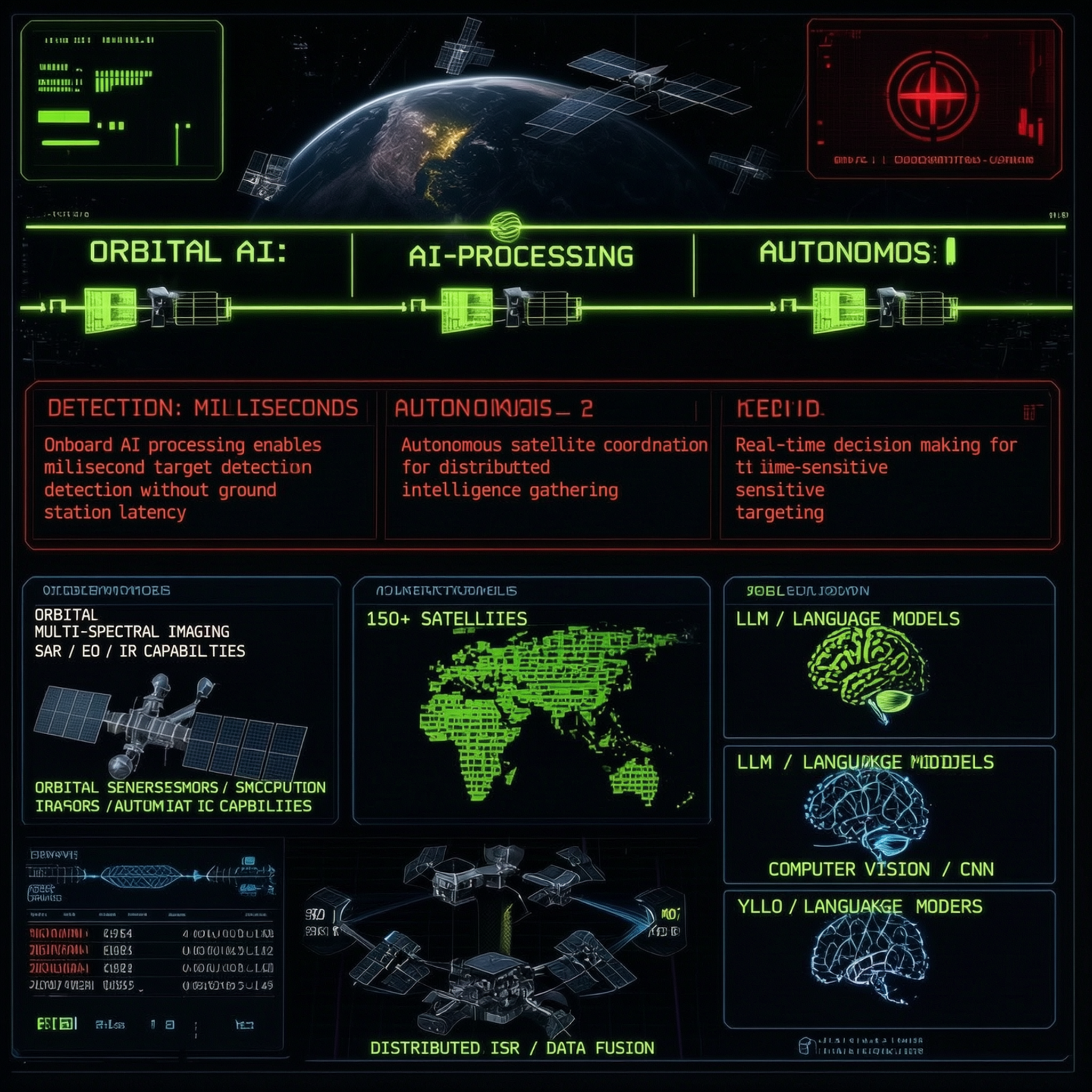
ARCHIVE #065 | TOPIC: AI-Enabled Military Satellites / US Convergence vs. China Air Target Agent System | STATUS: DUAL DEVELOPMENT CONFIRMED — ORBITAL AI RACE ACTIVE | CONFIDENCE: HIGH (program disclosure), MEDIUM (operational capability)
📡 THE SIGNAL
> BREAKING: Dual-track orbital AI development confirmed.
> US TRACK: Project “Convergence” — Prometheus AI system
> receives satellite imagery, scans/fuses data for threat
> detection and targeting. Military satellites to be
> equipped with onboard AI for troop movement tracking.
> Data fusion: multiple satellites, different sensors,
> same area → unified intelligence picture.
> CHINA TRACK: Air Target Agent System — integrates LLMs
> with satellites for fully autonomous military target
> analysis. Onboard processing: aircraft, missiles, UAVs
> identified directly in orbit (no ground station delay).
> AI models: YOLO, Faster R-CNN trained on satellite
> imagery for object detection.
> CONVERGENCE: Both powers moving toward autonomous
> orbital intelligence — millisecond target detection,
> no human operator in the loop for initial identification.
Two parallel developments signal a fundamental shift in military space operations: the United States and China are independently deploying artificial intelligence directly onto military satellites, enabling autonomous target detection, data fusion, and threat identification at orbital speed.
US Program — Convergence and Prometheus: The US military is developing Project Convergence, an architecture integrating satellite sensors with the Prometheus AI system. Orbital sensors collect battlefield imagery, transmit to Prometheus, which scans and fuses multi-source data to detect threats and generate targeting data. Future military satellites will be equipped with onboard AI for real-time tracking of ground troop movements — eliminating the latency of ground-station processing.
The data fusion concept is critical: multiple satellites observing the same area with different sensor technologies combine their information into a unified intelligence picture. This is not single-platform reconnaissance — it is distributed orbital intelligence.
Chinese Program — Air Target Agent System: Chinese aerospace researchers have developed and deployed the Air Target Agent System, which integrates Large Language Models (LLMs) with satellites for fully autonomous military target analysis. The breakthrough: onboard processing. Instead of transmitting all imagery to ground stations, the satellite itself identifies aircraft, missiles, and UAVs directly in orbit — reducing response time from minutes/hours to milliseconds.
The AI models employed include YOLO (You Only Look Once) and Faster R-CNN — computer vision architectures trained to detect objects in satellite imagery with superhuman speed and accuracy.
The strategic convergence: Both programs represent a shift from human-in-the-loop satellite operations (operators manually tasking sensors, receiving imagery, analyzing on ground) to autonomous orbital intelligence (AI on satellite identifies, classifies, and potentially tasks follow-on collection without human intervention). This is the OODA loop (Observe-Orient-Decide-Act) compressed to machine speed.
🔗 Sources: Russian7 | RusArgument | RBC Ukraine | Vietnam News
✅ WHAT’S CONFIRMED (FACTS)
→ US Project Convergence confirmed
US military developing Project Convergence integrating satellite sensors with AI for advanced reconnaissance. Multiple sources confirm program existence and strategic intent to challenge geopolitical competitors (primarily Russia).
→ Prometheus AI system documented
Prometheus AI system receives satellite imagery, scans and fuses multi-source data for threat detection and targeting data generation. This is the analytical core of the Convergence architecture.
→ Onboard satellite AI planned
US specialists plan to equip military satellites with onboard AI for real-time troop movement tracking. This represents shift from ground-based processing to orbital edge computing.
→ Data fusion capability confirmed
Multiple satellites observing same area with different sensor technologies will combine information into unified intelligence picture. This is distributed orbital ISR (Intelligence, Surveillance, Reconnaissance).
→ China Air Target Agent System deployed
Chinese aerospace researchers developed and deployed Air Target Agent System integrating LLMs with satellites for fully autonomous military target analysis. System is operational, not just conceptual.
→ Onboard processing confirmed (China)
Chinese satellites process imagery onboard — identifying aircraft, missiles, UAVs directly in orbit without ground station transmission. This eliminates latency of traditional satellite ISR.
→ YOLO and Faster R-CNN models deployed
Chinese system employs YOLO (You Only Look Once) and Faster R-CNN computer vision architectures trained on satellite imagery for object detection. These are established, proven AI models adapted for orbital application.
⚠️ WHAT REQUIRES CONTEXT
> CAUTION: DETECTION ≠ ENGAGEMENT | AUTONOMOUS IDENTIFICATION ≠ AUTONOMOUS WEAPONS | PROGRAM DISCLOSURE ≠ OPERATIONAL DEPLOYMENT🔍 “Find Chinese carrier strike group” — capability vs. deployment
The characterization that satellites will receive commands like “Find Chinese carrier strike group” and autonomously determine mission execution is analytical extrapolation, not documented operational doctrine. The capability (AI identifying targets) is confirmed; the operational concept (autonomous mission planning) is projected.
🔍 “Millisecond target detection” — technical claim vs. operational reality
Millisecond processing is technically plausible for AI inference on modern hardware. However, total system latency includes sensor collection, data transmission, processing, and dissemination. “Millisecond detection” may refer to AI inference time only, not end-to-end kill chain.
🔍 Autonomous targeting — ethical and strategic threshold
Autonomous target identification is distinct from autonomous engagement. Current systems appear to be ISR (Intelligence, Surveillance, Reconnaissance) — identifying and classifying targets. The step to autonomous weapons (AI authorizing engagement) represents a fundamental ethical and strategic threshold that has not been publicly crossed.
🎯 STRATEGIC BREAKDOWN: 6 KEY DIMENSIONS
> ORBITAL AI WARFARE: DECODED1. THE LATENCY REVOLUTION — FROM MINUTES TO MILLISECONDS
Traditional satellite ISR: collect imagery → transmit to ground → human analysis → disseminate intelligence. Timeline: minutes to hours. Orbital AI: collect imagery → onboard AI processing → immediate target identification. Timeline: milliseconds to seconds. This is not incremental improvement — it is orders-of-magnitude acceleration of the intelligence cycle. For time-sensitive targets (mobile missile launchers, carrier strike groups), this is the difference between actionable intelligence and historical record.
2. DATA FUSION — DISTRIBUTED ORBITAL INTELLIGENCE
Multiple satellites with different sensors (optical, SAR, infrared, electronic intelligence) observing the same area can fuse their data into unified intelligence picture. No single sensor provides complete information; fusion creates comprehensive understanding. This is networked ISR — the orbital equivalent of combined arms.
3. THE OODA LOOP COMPRESSION — MACHINE SPEED DECISION MAKING
Boyd’s OODA loop (Observe-Orient-Decide-Act) describes decision cycle in combat. Orbital AI compresses the Observe-Orient phases to machine speed. The human operator moves from active participant to supervisor — reviewing AI-generated intelligence rather than generating it. This is fundamental shift in human-machine teaming for military operations.
4. DUAL-USE TECHNOLOGY — ISR VS. TARGETING
The same AI that identifies and classifies targets for intelligence purposes can generate targeting data for weapons systems. The technical capability is identical; the operational employment differs. This dual-use nature creates ambiguity: is orbital AI for reconnaissance or for kill chain integration? The answer is likely both — the same system serves multiple functions.
5. THE SPACE RACE 2.0 — ORBITAL AI SUPREMACY
Both US and China are independently developing orbital AI — this is not cooperation, it’s competition. Whoever achieves superior orbital AI gains persistent, real-time intelligence advantage over adversary. This is the new space race: not flags and footprints, but algorithms and processing power. Orbital AI supremacy may be as decisive as nuclear superiority was in the Cold War.
6. COUNTERMEASURES AND VULNERABILITY — THE CAT-AND-MOUSE DYNAMIC
Orbital AI creates new vulnerabilities: adversary deception (decoys, camouflage optimized against AI detection), anti-satellite weapons (kinetic, electronic, cyber), and AI-specific countermeasures (adversarial examples confusing computer vision). Every capability generates counter-capability. The orbital AI race will include both offense and defense — attack the sensor, or blind the algorithm.
💬 CONCLUSION
Satellites with brains.
Processing at orbital speed.
Detecting in milliseconds.
No ground station.
No human analyst.
No minutes-long delay.
The question isn’t whether orbital AI works.
It does.
The question is whether human decision-making
can keep up with machine detection —
and whether the next step
is autonomous engagement.
The space race is no longer about flags.
It’s about algorithms.
Watch the launches.
Watch the models.
Watch who sees first —
and who acts fastest.
> ARCHIVE #065: LOGGED
> ACTION: TRACK CAPABILITY, NOT JUST CONCEPT
#OrbitalAI #ProjectConvergence #Prometheus #AirTargetAgent #MilitarySatellites #SpaceWarfare #ArchiveTheControlStack
→ archivethecontrolstack.substack.com
Archive The Control Stack — deconstructing signals in the age of information noise. Facts only. Clear structure. Minimal speculation.