
ARCHIVE #063: THE KHARG TRAP WHY SEIZURE OF IRAN'S OIL ISLAND BECOMES AMERICA'S MOST FATAL STRATEGIC ERROR

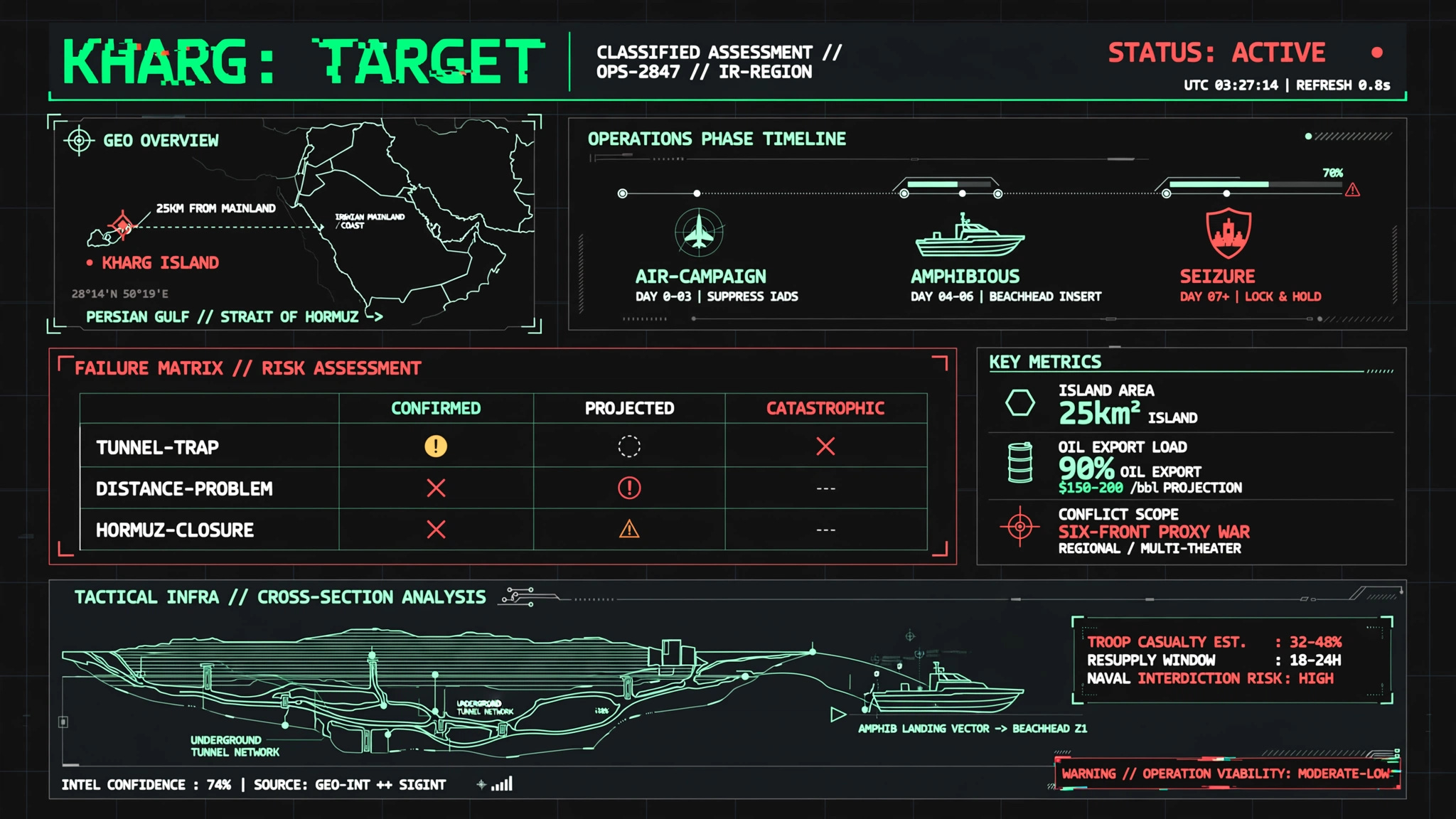
TOPIC: Kharg Island Seizure Scenario / US-Iran Escalation Analysis | STATUS: FORCE BUILDUP REPORTED — OPERATION UNAUTHORIZED | CONFIDENCE: HIGH (force positioning), LOW (operational intent)
📡 THE SIGNAL
> BREAKING: US-Iran air campaign exceeds 2 months.
> Two amphibious ready groups with thousands of
> Marines detected in Persian Gulf. White House
> corridors discussing Kharg Island seizure option.
> Kharg: 25 km² island, handles ~90% of Iranian
> oil exports. Located 25 km from Iranian coast.
> Defensive profile: 20-40m deep tunnel network
> in limestone, mined beaches, mobile coastal
> batteries, IRGC garrison.
> Strategic assessment: seizure = tactical success,
> strategic catastrophe. Oil price projection:
> $150-200/bbl. Hormuz closure likely. Six-front
> proxy war escalation probable.
As the US-Israeli air campaign against Iranian nuclear and military infrastructure enters its third month, Pentagon strategists are revisiting a decades-old contingency: seizure of Kharg Island — the tiny 25-square-kilometer node through which ~90% of Iran’s oil exports flow.
The operational signal is unmistakable: two amphibious ready groups with thousands of Marines have been detected in the Persian Gulf theater. White House discussions about “taking that piece of land” are leaking through familiar channels.
On paper, the operation appears elegant: a small island, decisive economic leverage, a surgical strike against the regime’s wallet. In reality, Kharg is a fortress — 25 kilometers from the Iranian mainland (point-blank range for missiles and drones), honeycombed with 20-40 meter deep tunnel networks carved into porous limestone, defended by layered minefields, concrete-encased machine gun positions, and mobile coastal batteries that constantly reposition to defeat targeting.
The analytical assessment is severe: seizure is tactically feasible; retention is strategically impossible. The island becomes a trap — a giant mouse trap where every wellhead, every building, every rock outcrop becomes a source of lethal threat from IRGC special forces emerging from tunnel exits behind Marine positions.
But the true catastrophe lies beyond Kharg’s shores. Seizure instantly transforms the conflict from limited air campaign into total regional war. Hormuz closes — not demonstratively, but physically, with thousands of mines and anti-ship missiles. Gulf state infrastructure (UAE, Saudi, Qatar) becomes legitimate Iranian target. Hezbollah, Iraqi Shia militias, and Houthis activate simultaneously. Oil prices spike to $150-200/barrel. Global recession becomes fact, not forecast.
🔗 Sources: Reuters | WSJ | CSIS | West Point Modern War
✅ WHAT’S CONFIRMED (FACTS)
→ Amphibious force buildup verified
Two amphibious ready groups with thousands of Marines detected in Persian Gulf theater. Force posture consistent with amphibious operation planning, though no authorization confirmed.
→ Kharg strategic importance documented
Kharg Island handles approximately 90% of Iranian oil exports. 25 km² area, 25 km from Iranian mainland. Critical economic chokepoint for Islamic Republic.
→ Defensive infrastructure confirmed
Iranian military has fortified Kharg for decades: tunnel networks (20-40m deep in limestone), mined beaches, concrete-emplaced positions, mobile coastal batteries. Island designed as fortress against superior force.
→ Air campaign duration confirmed
US-Israeli air campaign against Iranian nuclear and military infrastructure has exceeded two months. Limited strategic effect on regime behavior despite tactical damage to IRGC and enrichment facilities.
→ Gulf state warnings documented
GCC allies have privately warned Washington against ground invasion. Regional partners understand Kharg seizure triggers uncontrollable escalation against their own infrastructure.
⚠️ WHAT REQUIRES CONTEXT
> CAUTION: FORCE POSTURE ≠ OPERATIONAL INTENT | SCENARIO PLANNING ≠ DECISION MADE🔍 “Amphibious groups detected” — contingency vs. execution
Force presence indicates planning capability, not operational authorization. US routinely maintains amphibious readiness in CENTCOM AOR. Presence creates option; it does not confirm decision. Historical pattern: every US president since Carter has considered and rejected Kharg seizure.
🔍 “$150-200/bbl oil” — analytical projection vs. market reality
Oil price projections depend on multiple variables: duration of Hormuz closure, strategic petroleum reserve releases, OPEC+ spare capacity activation, demand destruction. Extreme scenarios are possible but not deterministic.
🔍 “Six-front war” — escalation cascade vs. controlled response
Proxy activation is probable but scale and coordination remain uncertain. Iran’s proxy network has shown capability but also restraint in previous escalations. Maximum escalation is one outcome among several.
🎯 STRATEGIC BREAKDOWN: 6 KEY FAILURE MODES
> KHARG SEIZURE FAILURE CASCADE: DECODED1. THE DISTANCE PROBLEM — 25 KM IS POINT-BLANK
Kharg sits 25 km from Iranian coast — distance modern missiles, drones, and artillery treat as point-blank. Every Marine on the island is within lethal range of mainland-based systems. There is no operational depth, no maneuver space, no safe rear area. The island is a target, not a base.
2. THE TUNNEL TRAP — SUBSURFACE DEFENSE
20-40 meter deep tunnel networks in porous limestone defeat penetrating munitions. IRGC forces survive aerial bombardment, then emerge through dozens of concealed exits behind advancing Marines. Every building, every wellhead, every rock becomes potential ambush point. Kharg becomes a giant mouse trap.
3. THE ASYMMETRIC SWARM — NAVAL GUERRILLA WARFARE
Iranian asymmetric naval doctrine: thousands of fast attack craft with missile launchers, swarms of kamikaze drones with fragmentation warheads optimized for anti-personnel effects on open beaches. Landing forces face saturation attacks unseen in Middle East since WWII-era amphibious operations.
4. THE RETENTION IMPOSSIBLE — LOGISTICS UNDER FIRE
Seizure is one problem; retention is another entirely. Garrison requires continuous sealift under constant fire from mainland. Every supply ship is a target. Every helicopter flight is contested. The occupation becomes a bleeding wound, consuming forces faster than they can be rotated.
5. THE HORMUZ CLOSURE — ENERGY APOCALYPSE
Iran responds to Kharg seizure with physical Hormuz closure — thousands of mines, anti-ship missiles, swarming attacks on tankers. Not demonstrative but actual. Oil prices spike to $150-200/bbl. Gasoline hits $10-12/gallon in US. Global recession exceeds 2008 crisis. The operation intended to strangle Iran’s economy strangles the global economy instead.
6. THE SIX-FRONT ACTIVATION — PROXY WAR EXPLOSION
Hezbollah (100,000+ rockets targeting all Israel), Iraqi Shia militias (mass attacks on US bases in Iraq/Syria), Houthis (deadliest Iranian arsenal unleashed against Saudi/UAE) — all activate simultaneously. Six fronts, none closeable by air power alone. Each requires ground forces and years of occupation — political resources American society no longer possesses.
📜 THE KHARG SYNDROME — HISTORICAL PATTERN
> EVERY US PRESIDENT SINCE CARTER HAS CONSIDERED
> AND REJECTED KHARG SEIZURE. THE REASONS REMAIN
> IDENTICAL. THE TEMPTATION NEVER DISAPPEARS.
The “Kharg Syndrome” is a recurring strategic temptation: the seductive promise of a quick, decisive blow against Iran’s economic lifeline. Every American president since Carter has faced this option; every one has ultimately rejected it. The reasons remain constant across administrations:
• Tactical success ≠ Strategic victory — Seizing the island does not break the regime; it unleashes uncontrollable escalation.
• Iranian resilience — Forty years of sanctions and isolation have created a regime adapted to survival under total blockade. Loss of Kharg does not produce capitulation; it produces total war.
• Historical analogy failure — Britain’s loss of Singapore (1942) did not produce surrender; it produced total mobilization. Iran’s response to Kharg loss follows the same pattern, not the “decisive blow” model.
• American strategic exhaustion — Two decades of Middle Eastern ground wars have depleted political capital for occupation campaigns. The American public has no appetite for another open-ended commitment.
💬 CONCLUSION
Twenty-five square kilometers.
Twenty-five kilometers from hell.
Ninety percent of a nation’s oil.
On paper: elegant solution.
In reality: strategic trap.
The question isn’t whether America can take Kharg.
It can.
The question is whether America can keep it —
and survive what comes after.
The smart player doesn’t poke the hornet’s nest
with a stick.
He avoids it entirely.
Kharg today is a hornet’s nest
the size of a city.
Whoever puts his hand inside
will never be able
to make a fist again.
> SIGNAL LOG: FORCE BUILDUP REPORTED — OPERATION UNAUTHORIZED
> ACTION: TRACK AUTHORIZATION, NOT JUST CAPABILITY
#KhargIsland #USIranConflict #PersianGulf #AmphibiousOperations #StrategicTrap #HormuzClosure #TheControlStack
→ thecontrolstack.blogspot.com
The Control Stack — signal analytics in a noisy world. Facts only. Clear structure. Minimal speculation.