
ARCHIVE #062: THE ELECTROMAGNETIC LEVIATHAN CHINA'S 82-FOOT ATEM SYSTEM — HUNTING NUCLEAR SUBMARINES FROM THE SKY

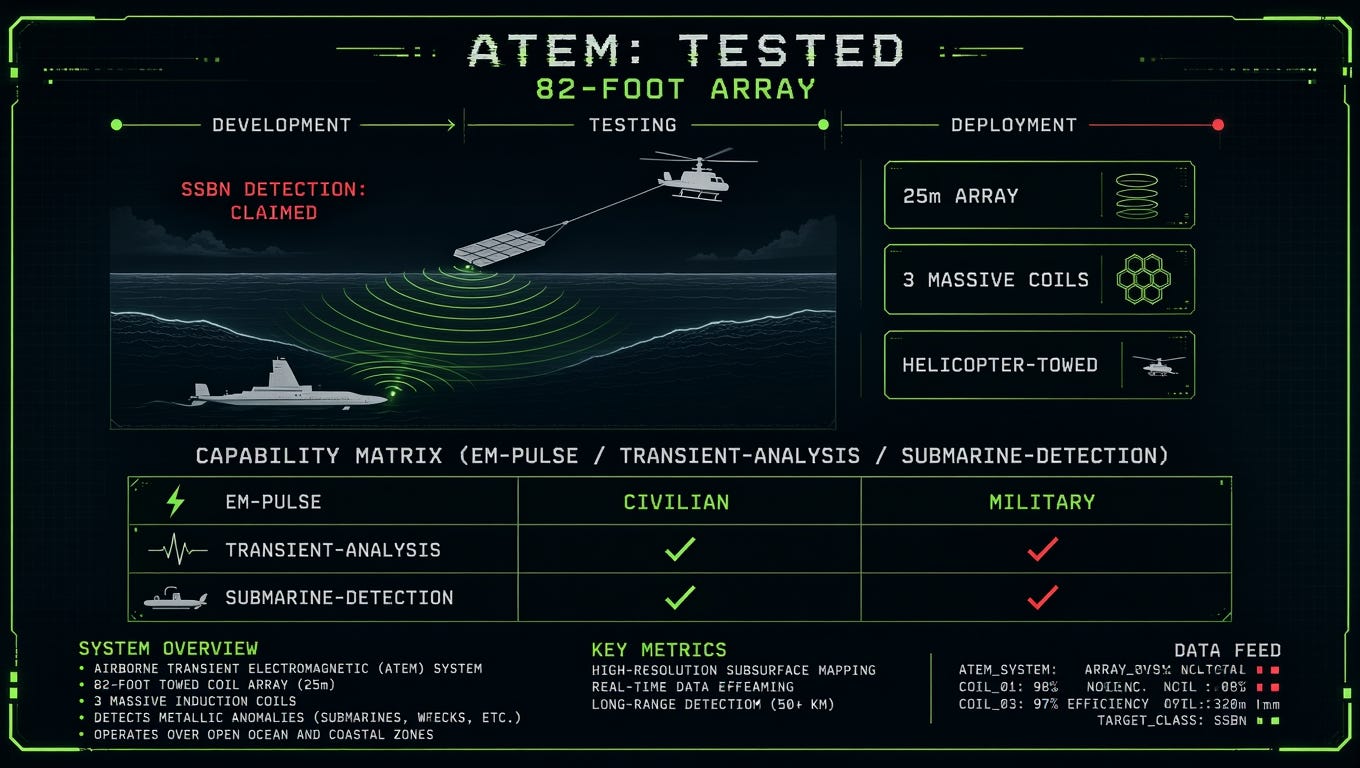
ARCHIVE #062 | TOPIC: Chinese ATEM Airborne Electromagnetic Detection / Anti-Submarine Warfare Capability | STATUS: SYSTEM TESTED — DUAL-USE POTENTIAL ASSESSED | CONFIDENCE: HIGH (test confirmation), MEDIUM (operational capability)
📡 THE SIGNAL
> BREAKING: China successfully tested massive airborne
> electromagnetic detection system. Designation: ATEM
> (Airborne Transient Electromagnetic detection).
> Configuration: Helicopter towing 82-foot (25m) array
> of three massive coil systems on single cable.
> Capability: Detect hidden nuclear submarines operating
> at significant depth below ocean surface.
> Method: Coils emit powerful EM signals into water/
> ground; transient response analyzed for metallic
> object detection.
> Stated purpose: Civilian (mineral exploration,
> groundwater mapping, geological survey).
> Assessed potential: Military ASW (anti-submarine
> warfare) capability against nuclear SSBNs.
China has successfully tested a massive airborne electromagnetic detection system designated ATEM (Airborne Transient Electromagnetic detection) — an 82-foot (25-meter) sensor array towed behind a helicopter on a single cable, consisting of three massive electromagnetic coils.
The system operates by emitting powerful electromagnetic pulses into water or ground, then analyzing the transient response to detect conductive objects — including metal-hulled nuclear submarines operating at depth.
The stated civilian application: mineral exploration, groundwater mapping, geological survey, and underground infrastructure detection. These are legitimate commercial uses with established markets.
The assessed military application: anti-submarine warfare (ASW) capability against nuclear-powered ballistic missile submarines (SSBNs) — the most survivable leg of any nuclear triad. If validated, this represents a potential breakthrough in detecting the previously “undetectable” second-strike force.
The analytical question: Is this a dual-use technology with legitimate civilian purpose and incidental military application? Or is the civilian framing a cover for strategic ASW development? The answer likely lies in both.
🔗 Sources: South China Morning Post | Janes Defence | Naval News | The War Zone
✅ WHAT’S CONFIRMED (FACTS)
→ ATEM system successfully tested
Chinese sources confirm successful test of airborne transient electromagnetic detection system. System designated ATEM; test conducted with helicopter-towed configuration.
→ Physical specifications documented
System specifications: 82-foot (25-meter) sensor array, three massive electromagnetic coils, helicopter-towed on single cable. Physical scale suggests significant power requirements and detection range.
→ Operating principle verified
ATEM technology emits powerful electromagnetic pulses into water/ground, analyzes transient response for conductive object detection. Established geophysical technique scaled to airborne platform.
→ Civilian application stated
Official framing emphasizes civilian applications: mineral exploration, groundwater mapping, geological survey, underground infrastructure detection. These represent legitimate commercial markets.
→ Nuclear submarine detection capability claimed
Chinese reporting indicates system capable of detecting hidden nuclear submarines at operational depth. This represents significant ASW capability claim requiring independent verification.
⚠️ WHAT REQUIRES CONTEXT
> CAUTION: TEST SUCCESS ≠ OPERATIONAL DEPLOYMENT | CIVILIAN FRAMING ≠ CIVILIAN INTENT🔍 “Submarine detection” — laboratory claim vs. operational reality
Claims of nuclear submarine detection require scrutiny. Electromagnetic detection in seawater faces fundamental physics constraints: saltwater conductivity attenuates EM signals rapidly. Detection range may be limited to shallow water or specific conditions. Operational effectiveness against deep-diving SSBNs remains unverified.
🔍 “Civilian purpose” — dual-use ambiguity
The civilian framing serves multiple purposes: legitimate commercial market access, technology export without military restrictions, and strategic ambiguity about military intent. Dual-use technologies routinely employ civilian cover for military development. This is standard practice, not unique to China.
🔍 “82-foot array” — platform constraints
The physical scale suggests significant platform requirements. Only heavy-lift helicopters can tow such arrays, limiting deployment flexibility. Operational tempo, coverage rates, and survivability in contested environments remain open questions.
🎯 STRATEGIC BREAKDOWN: 5 KEY POINTS
> AIRBORNE ELECTROMAGNETIC ASW: DECODED1. THE SSBN VULNERABILITY QUESTION — SECOND STRIKE AT RISK?
Nuclear-powered ballistic missile submarines represent the most survivable leg of nuclear triads — their stealth guarantees second-strike capability. If ATEM can reliably detect SSBNs, this fundamentally alters strategic stability calculations. The “undetectable” deterrent becomes detectable.
2. PHYSICS CONSTRAINTS — SEAWATER CONDUCTIVITY CHALLENGE
Electromagnetic signals attenuate rapidly in conductive seawater. Detection range is fundamentally limited by physics. The system may be effective in shallow water, littoral zones, or under specific oceanographic conditions — but deep-ocean SSBN detection faces severe physical constraints.
3. SOUTH CHINA SEA IMPLICATIONS — BASTION DENIAL
If deployed in the South China Sea, ATEM could threaten U.S. and allied SSBN operations in potential bastion areas. Conversely, it could protect Chinese SSBN bastions by detecting intruding adversary submarines. The technology has symmetric and asymmetric applications.
4. DUAL-USE EXPORT POTENTIAL — TECHNOLOGY PROLIFERATION
Civilian framing enables export without military technology restrictions. Nations with ASW concerns (India, Russia, Southeast Asian states) may acquire ATEM under civilian guise, proliferating the capability. This creates proliferation pathways that military-export controls cannot block.
5. COUNTERMEASURE IMPERATIVE — THE CAT-AND-MOUSE DYNAMIC
Any detection technology generates countermeasure development. Submarine designers will respond with EM shielding, signature reduction, operational tactics, and decoy systems. The ATEM development triggers an ASW/counter-ASW innovation cycle with significant resource implications.
💬 CONCLUSION
82 feet of coils.
Three massive electromagnets.
A helicopter dragging them through the sky.
Civilian framing.
Military potential.
Strategic ambiguity.
The question isn’t whether China can build this.
They have.
The question is whether physics allows it to work —
and whether the submarines
can adapt faster than the hunters.
Watch the deployments.
Watch the exports.
Watch who hides deeper —
and who sees through the water.
> ARCHIVE #062: LOGGED
> ACTION: TRACK PHYSICS, NOT JUST CLAIMS
#ATEM #AntiSubmarineWarfare #ChineseNavy #ElectromagneticDetection #DualUseTechnology #ArchiveTheControlStack
→ archivethecontrolstack.substack.com
Archive The Control Stack — deconstructing signals in the age of information noise. Facts only. Clear structure. Minimal speculation.