
ARCHIVE #061: THE JURISDICTION PLAY CHINA LAUNCHES MARITIME LAW ENFORCEMENT OPERATION EAST OF TAIWAN

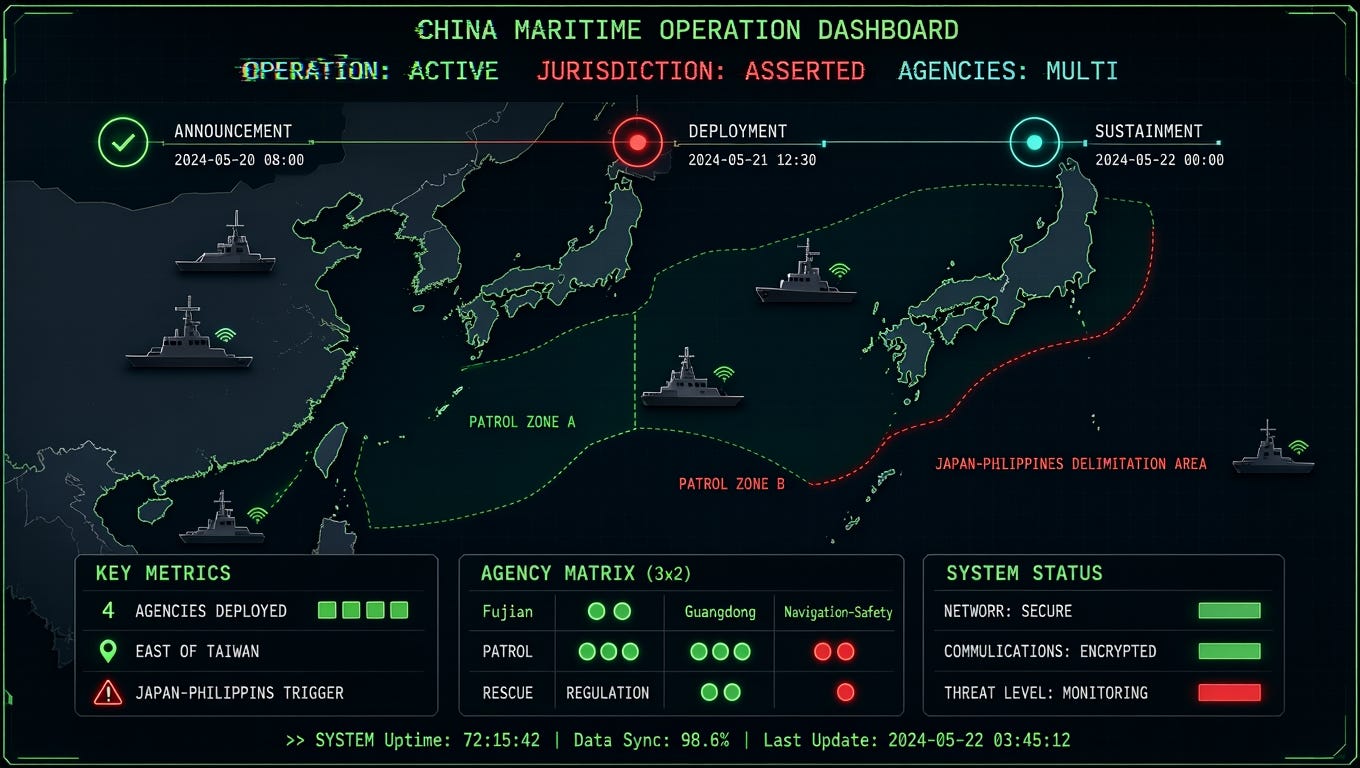
ARCHIVE #061 | TOPIC: China Maritime Law Enforcement Operation / Taiwan Strait Jurisdiction Assertion | STATUS: OPERATION CONFIRMED — MULTI-AGENCY DEPLOYMENT ACTIVE | CONFIDENCE: HIGH (official announcement), MEDIUM (operational scope)
📡 THE SIGNAL
> BREAKING: China launches special maritime law enforcement
> operation east of Taiwan. Agencies: Fujian Maritime Bureau,
> Guangdong Maritime Bureau, East China Sea Navigation Safety
> Center, East China Sea Rescue Bureau.
> Stated purpose: “exercise maritime administrative jurisdiction”
> and “protect national interests.”
> Trigger: Japan-Philippines maritime boundary delimitation
> negotiations. China declares talks “illegal and invalid.”
> Operations: enhanced patrols, shipping regulation,
> deep-water surveillance, jurisdiction assertion.
China has launched a special maritime law enforcement operation in waters east of Taiwan — a coordinated multi-agency deployment involving the Fujian Maritime Bureau, Guangdong Maritime Bureau, East China Sea Navigation Safety Center, and East China Sea Rescue Bureau.
The official framing: this is not a military operation but a “law enforcement mission” to exercise China’s “maritime administrative jurisdiction” and “protect national interests” in what Beijing considers its sovereign waters.
The trigger: Japan-Philippines negotiations on maritime boundary delimitation in waters east of Taiwan. China’s Ministry of Foreign Affairs has declared these talks “absolutely illegal and invalid”, asserting they violate China’s territorial sovereignty and maritime rights.
Operational scope: enhanced patrols, shipping regulation, deep-water surveillance, and administrative jurisdiction enforcement. The multi-agency nature signals institutional coordination — this is not an ad hoc response but a structured assertion of governance claims.
The analytical significance: China is employing gray zone tactics — using coast guard and maritime bureau assets (not PLAN warships) to assert sovereignty below the threshold of armed conflict. This is lawfare: using legal and administrative frameworks as instruments of strategic competition.
🔗 Sources: Bloomberg | RBC Ukraine | UNN | News.ru
✅ WHAT’S CONFIRMED (FACTS)
→ Special maritime operation confirmed
China officially announced special maritime law enforcement operation in waters east of Taiwan. Bloomberg and multiple international outlets confirm the deployment.
→ Multi-agency participation documented
Participating agencies: Fujian Maritime Bureau, Guangdong Maritime Bureau, East China Sea Navigation Safety Center, East China Sea Rescue Bureau. This is coordinated inter-agency deployment, not single-service operation.
→ Japan-Philippines delimitation as stated trigger
China’s Ministry of Foreign Affairs explicitly links operation to Japan-Philippines maritime boundary negotiations. Official statement declares talks “absolutely illegal and invalid” and asserts they do not affect China’s claims.
→ Operational scope defined
Stated operations: enhanced patrols, shipping regulation, deep-water surveillance, administrative jurisdiction enforcement. Law enforcement framing (not military) is deliberate strategic choice.
→ “Administrative jurisdiction” as sovereignty tool
Official purpose: “exercise maritime administrative jurisdiction” and “protect national interests.” This legal-administrative framing transforms sovereignty claims into operational governance.
⚠️ WHAT REQUIRES CONTEXT
> CAUTION: LAW ENFORCEMENT ≠ MILITARY OPERATION | JURISDICTION ≠ SOVEREIGNTY🔍 “Law enforcement operation” — deliberate framing choice
China deliberately frames this as law enforcement (coast guard/maritime bureau) rather than military (PLAN). This keeps operations below the threshold of armed conflict while asserting governance claims. The framing is strategic: it makes response options for other states more constrained.
🔍 “Administrative jurisdiction” — salami slicing sovereignty
By conducting “administrative jurisdiction” operations, China incrementally establishes governance presence. Each patrol, each shipping regulation, each enforcement action creates precedent. This is sovereignty by accumulation — the “salami slicing” strategy applied to maritime domains.
🔍 Japan-Philippines delimitation — the coalition factor
The Japan-Philippines maritime boundary talks represent a coalition forming against China’s expansive claims. China’s response signals: bilateral arrangements among claimants will not be accepted. This is about preventing the formation of unified opposing positions.
🎯 STRATEGIC BREAKDOWN: 5 KEY POINTS
> MARITIME GRAY ZONE OPERATIONS: DECODED1. GRAY ZONE TACTICS — BELOW THE THRESHOLD
Using coast guard and maritime bureau assets (not military) keeps operations below the threshold that would trigger mutual defense treaties or military response. This is the essence of gray zone warfare: achieving strategic objectives through means that don’t justify conventional military counter-action.
2. LAWFARE — LEGAL FRAMEWORKS AS WEAPONS
China is weaponizing legal and administrative concepts. “Maritime administrative jurisdiction” transforms contested sovereignty claims into operational governance. Each enforcement action creates precedent; each precedent strengthens the legal claim. This is law as instrument of power.
3. MULTI-AGENCY COORDINATION — INSTITUTIONAL CAPABILITY SIGNAL
The involvement of four distinct agencies (Fujian, Guangdong, Navigation Safety, Rescue) demonstrates institutional coordination capability. This is not ad hoc response but structured, repeatable operational doctrine. The message: China can sustain this indefinitely.
4. THE JAPAN-PHILIPPINES FACTOR — COALITION DETERRENCE
Japan-Philippines maritime delimitation represents emerging coalition against China’s expansive claims. China’s operation signals: bilateral arrangements excluding Beijing will not be accepted. This is about preventing formation of unified opposing positions among Southeast Asian claimants and their allies.
5. TAIWAN DIMENSION — SOVEREIGNTY INTEGRATION
Operations “east of Taiwan” are not just about maritime boundaries — they’re about integrating Taiwan into China’s administrative framework. Each law enforcement action in these waters treats Taiwan as part of China’s domestic governance structure. This is sovereignty assertion through operational practice.
💬 CONCLUSION
Not warships. Coast guard.
Not military. Law enforcement.
Not conquest. Jurisdiction.
This is how sovereignty is taken
in the 21st century:
not with declarations,
but with patrols.
The question isn’t whether China can operate here.
It can.
The question is whether anyone will contest
each patrol, each regulation,
each assertion of governance —
or whether accumulation becomes acceptance.
Watch the patrols.
Watch the precedents.
Watch who blinks first
in the gray zone.
> ARCHIVE #061: LOGGED
> ACTION: TRACK PRECEDENTS, NOT JUST PRESENCE
#ChinaMaritimeOperation #TaiwanStrait #GrayZoneWarfare #Lawfare #MaritimeJurisdiction #ArchiveTheControlStack
→ archivethecontrolstack.substack.com
Archive The Control Stack — deconstructing signals in the age of information noise. Facts only. Clear structure. Minimal speculation.