
ARCHIVE #060: THE ALGORITHMIC FRONTLINE PALANTIR PRISMA — AI-OPTIMIZED DEEP STRIKE COMMAND SYSTEM IN UKRAINE

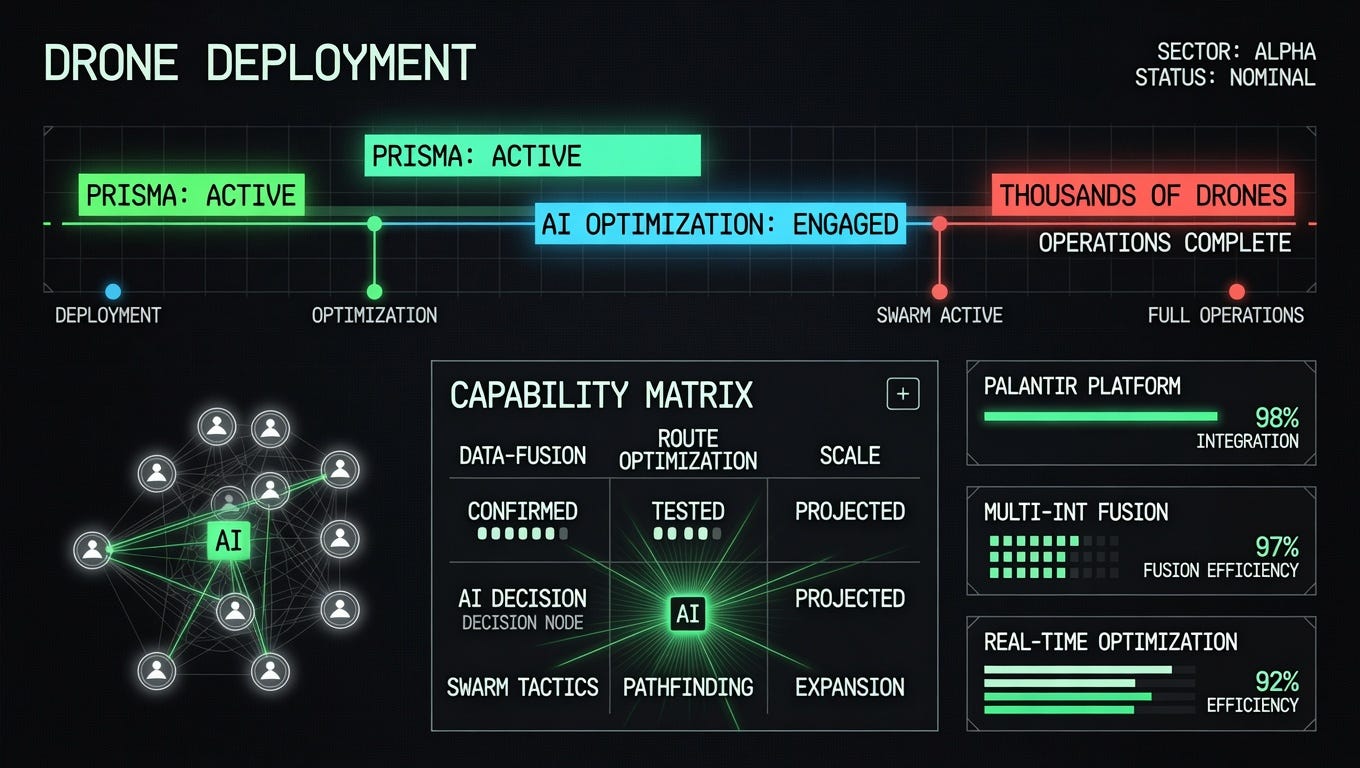
ARCHIVE #060 | TOPIC: Palantir Prisma AI Command System / Ukrainian Deep Strike Operations | STATUS: SYSTEM DEPLOYMENT CONFIRMED — OPERATIONAL EFFECTIVENESS ASSESSED | CONFIDENCE: HIGH (official confirmation), MEDIUM (combat performance data)
📡 THE SIGNAL
> BREAKING: CNN reveals Ukrainian GUR command center
> utilizing Palantir Technologies’ Prisma AI platform
> for deep-strike drone operations into Russia.
> Capability: AI analyzes thousands of parameters
> (PVO interception zones, satellite imagery, SIGINT,
> drone telemetry) to calculate optimal penetration
> routes through Russian air defense gaps.
> Official confirmation: Defense Minister Fedorov
> (May 12, 2026) — “AI solutions integrated into
> deep strike planning with Palantir.”
CNN has exposed a previously opaque capability: Ukraine’s Main Intelligence Directorate (GUR) operates an AI-powered command and control center built on Palantir Technologies’ Prisma platform, managing long-range drone strikes deep into Russian territory.
The system’s function: real-time orchestration of thousands of drones simultaneously, analyzing massive datasets including: Russian air defense interception patterns, satellite imagery, signals intelligence (SIGINT), telemetry from previously downed drones, and mobile air defense system tracking (Pantsir systems).
The algorithmic advantage: After each strike wave, the AI recalculates “gaps” in Russian air defense coverage and generates optimal penetration routes for subsequent waves — exploiting vulnerabilities faster than human operators could identify them.
Official confirmation came May 12, 2026, when Ukrainian Defense Minister Mykhailo Fedorov stated: “In cooperation with Palantir, we have implemented AI solutions and integrated them into deep strike operation planning.”
The strategic implication: This represents algorithmic warfare at operational scale — machine learning systems making real-time tactical decisions about route optimization, target prioritization, and resource allocation across thousands of autonomous and semi-autonomous platforms. The human role shifts from operator to supervisor.
🔗 Sources: CNN/YouTube | EADaily | 24tv.ua | Palantir Technologies
✅ WHAT’S CONFIRMED (FACTS)
→ Palantir Prisma deployment confirmed
CNN footage reveals Ukrainian GUR command center utilizing Palantir Technologies’ Prisma platform for managing long-range drone strike operations into Russian territory. System visualization shows real-time drone tracking and route optimization.
→ Official government acknowledgment
Ukrainian Defense Minister Mykhailo Fedorov confirmed May 12, 2026: “In cooperation with Palantir, we have implemented AI solutions and integrated them into deep strike operation planning.” This is official state-level confirmation, not speculation.
→ Multi-source data integration verified
Prisma platform analyzes: Russian air defense interception patterns, satellite imagery, signals intelligence (SIGINT), telemetry from downed drones, and mobile air defense system tracking (Pantsir systems). This is multi-INT (intelligence) fusion at operational tempo.
→ Scale: thousands of drones managed simultaneously
System capability includes real-time management of thousands of drones simultaneously during flight operations. This represents industrial-scale autonomous system coordination, not individual platform control.
→ AI route optimization through PVO gaps
Machine learning algorithms analyze Russian air defense interception zones and calculate optimal penetration routes through identified gaps (”holes” in coverage). After each wave, AI recalculates and provides operators with optimized routes for subsequent strikes.
⚠️ WHAT REQUIRES CONTEXT
> CAUTION: AI RECOMMENDATION ≠ AUTONOMOUS DECISION | OPTIMIZATION ≠ GUARANTEED SUCCESS🔍 “AI selects routes” — decision support vs. autonomous control
The system generates optimal route recommendations; human operators retain final approval authority. This is “human-in-the-loop” AI, not fully autonomous weapons systems. The distinction matters for accountability and escalation control.
🔍 “Thousands of parameters” — marketing language vs. technical specificity
“Thousands of parameters” is evocative but imprecise. Palantir’s platforms are known for multi-source data fusion, but specific parameter counts, weighting algorithms, and confidence thresholds are not publicly disclosed. Capability is real; specifics are classified.
🔍 Operational effectiveness — unquantified success rate
While system deployment is confirmed, actual penetration success rates, strike effectiveness metrics, and comparative performance (AI-optimized vs. human-planned routes) are not publicly available. Capability exists; effectiveness requires classified assessment.
🎯 STRATEGIC BREAKDOWN: 5 KEY POINTS
> AI-ENABLED WARFARE: DECODED1. ALGORITHMIC ADAPTATION — MACHINE SPEED VS. HUMAN SPEED
Russian air defenses adapt after each strike; Ukrainian AI adapts faster. The system identifies patterns in Russian interception zones and exploits gaps before human operators could recognize them. This is OODA loop (Observe-Orient-Decide-Act) compression through machine learning.
2. PALANTIR’S DUAL-USE STRATEGY — COMMERCIAL PLATFORM, MILITARY APPLICATION
Palantir Technologies builds commercial data analytics platforms (Gotham, Foundry, Prisma) with military applications. Ukraine represents live combat validation; success here drives adoption by NATO and allied forces. This is Silicon Valley defense industrial base evolution.
3. SCALE AS STRATEGIC ADVANTAGE — THOUSANDS OF DRONES
Managing thousands of drones simultaneously exceeds human cognitive capacity. AI coordination enables industrial-scale drone warfare that would be impossible with manual control. This is force multiplication through automation.
4. MULTI-INT FUSION — THE INTELLIGENCE ADVANTAGE
Combining satellite imagery, SIGINT, drone telemetry, and air defense tracking creates comprehensive operational picture. The AI doesn’t just process more data; it identifies correlations humans would miss. This is intelligence fusion at machine speed.
5. THE HUMAN SUPERVISOR MODEL — FROM OPERATOR TO OVERSEER
Ukrainian operators shift from manual route planning to AI recommendation review and approval. This changes skill requirements: less technical planning, more strategic judgment. The human role evolves but doesn’t disappear — yet.
💬 CONCLUSION
AI plans the route.
Humans approve the strike.
Drones execute the mission.
This is not automation.
It’s augmentation.
The question isn’t whether AI can optimize routes.
It can.
The question is whether humans can keep up —
with algorithmic adaptation,
with machine speed,
with the future of warfare.
Watch the algorithms.
Watch the adaptations.
Watch who learns faster —
the AI or the adversary.
> ARCHIVE #060: LOGGED
> ACTION: TRACK ADAPTATION, NOT JUST AUTOMATION
#PalantirPrisma #AIWarfare #UkraineDrones #AlgorithmicWarfare #DeepStrike #MachineLearning #ArchiveTheControlStack
→ archivethecontrolstack.substack.com
Archive The Control Stack — deconstructing signals in the age of information noise. Facts only. Clear structure. Minimal speculation.