
ARCHIVE #058: THE HAPPINESS PROTOCOL NEWTON HOWARD, KIWI, AND THE DUAL-USE NEUROTECHNOLOGY QUESTION

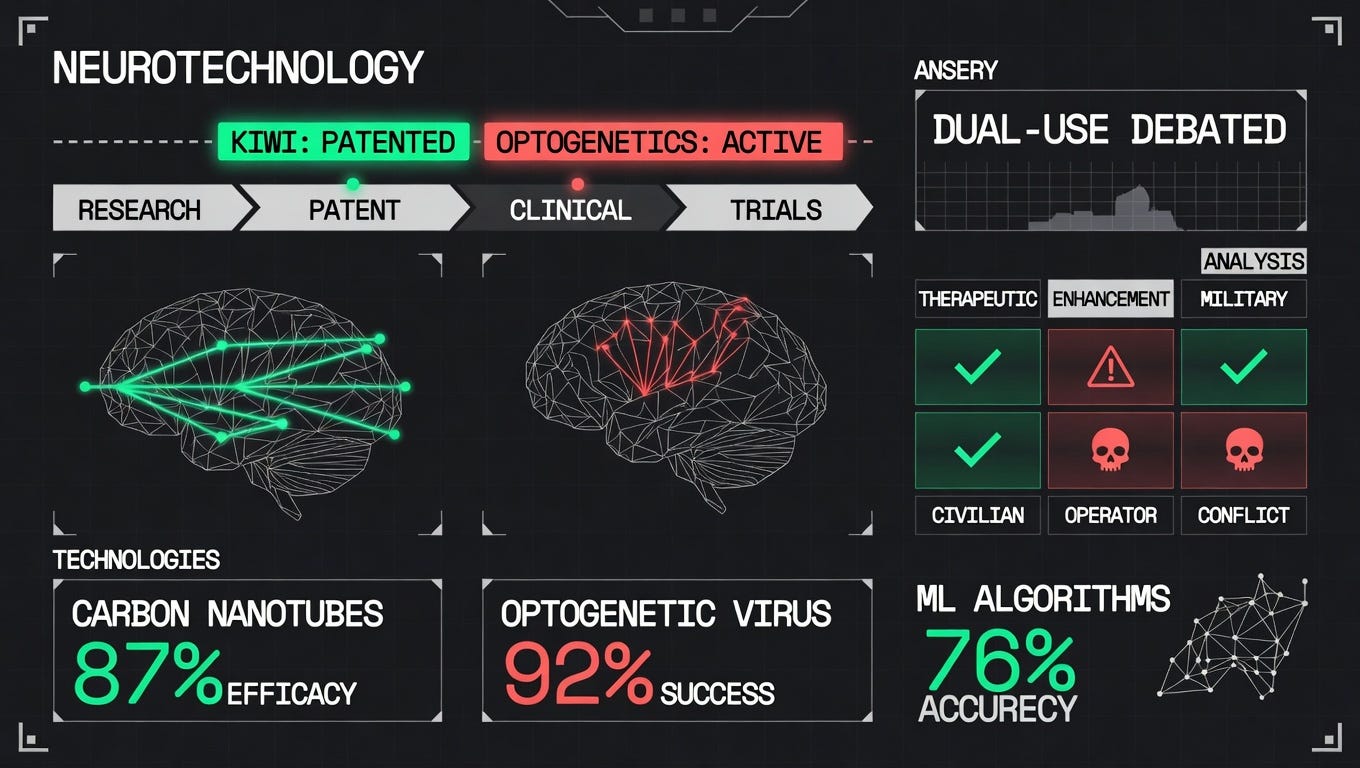
ARCHIVE #058 | TOPIC: KIWI Neurotechnology / Dual-Use Implications | STATUS: PATENT CONFIRMED — COGNITIVE CONTROL CLAIMS UNVERIFIED | CONFIDENCE: HIGH (technical documentation), LOW (operational capability)
📡 THE SIGNAL
> BREAKING: Newton Howard (ni2o/KIWI) patents brain-computer
> interface algorithm. Technology: carbon nanotubes +
> optogenetics + ML algorithms for neural modulation.
> Claimed capability: emotional state modulation, memory
> processing, cognitive function adjustment.
> Affiliation: DARPA funding; Howard on Kyiv School of
> Economics board (2025).
> Verification: patent confirmed; “root access to brain”
> framing = journalistic metaphor, not technical specification.
Newton Howard — American neuroscientist, founder of ni2o, and developer of the KIWI brain-computer interface — has published a new patent describing the algorithmic logic for neural modulation. The technology: carbon nanotubes delivering light pulses to optogenetically-modified neurons, controlled by machine learning algorithms.
The stated medical purpose: treatment of neurodegenerative diseases, depression, and cognitive disorders. The patent describes a “biological-computational state vector” capable of modeling multiple neural states and guiding the brain toward therapeutic outcomes — for example, shifting from depressive to neutral affective states.
The controversial framing: media and analytical summaries characterize this as “root access to the brain”, “jailbreaking human cognition”, or “quantum-like superposition for emotional control.” These are evocative metaphors — not direct quotations from patent text.
The dual-use question: Howard joined the Kyiv School of Economics board of directors in 2025. KSE has ties to Ukrainian defense-industrial analysis. If KIWI technology has military applications (soldier resilience, trauma mitigation, cognitive enhancement), does Ukrainian access to Howard’s research represent legitimate academic collaboration — or a testing ground for Pentagon neurotechnology?
Critical distinction: The patent is real. The therapeutic intent is documented. The “mind control” framing is interpretive — plausible given dual-use precedent, but not confirmed by technical documentation.
🔗 Sources: ni2o | USPTO | Kyiv School of Economics | DARPA
✅ WHAT’S CONFIRMED (FACTS)
→ Newton Howard / ni2o / KIWI affiliation confirmed
Newton Howard is founder of ni2o, developer of KIWI brain-computer interface. Company website describes KIWI as minimally invasive implant for reading neural activity and delivering electrical/optical signals via machine learning algorithms.
→ Patent documentation verified
US patent publications describe algorithmic framework for neural state modulation using optogenetics and nanotube-based light delivery. Technical claims focus on therapeutic applications: depression, neurodegenerative disease, cognitive monitoring.
→ DARPA funding connection documented
Howard’s research has received DARPA support. DARPA’s mandate includes dual-use neurotechnology: medical applications and military operator enhancement. This funding relationship is public record.
→ Kyiv School of Economics board membership confirmed
Newton Howard joined KSE board of directors in 2025. KSE engages in economic policy analysis with defense-industrial relevance. Academic collaboration is documented; military technology transfer is not.
⚠️ WHAT REQUIRES CONTEXT
> CAUTION: THERAPEUTIC INTENT ≠ MILITARY APPLICATION | PATENT CLAIMS ≠ OPERATIONAL CAPABILITY🔍 “Root access to the brain” — metaphor, not specification
Patent language describes neural state modeling and therapeutic modulation. Phrases like “root access,” “jailbreak,” or “quantum superposition” are journalistic framings that amplify technical concepts for narrative impact. They are not direct patent quotations.
🔍 “Erasing fear, changing memory” — extrapolation, not documentation
While optogenetics can modulate neural activity associated with fear or memory in laboratory settings, human applications remain experimental. The patent focuses on therapeutic monitoring and modulation, not wholesale memory editing or emotional erasure.
🔍 KSE affiliation — academic collaboration vs. technology transfer
Howard’s KSE board membership is documented. Whether this facilitates neurotechnology testing in Ukraine is speculative. Academic boards enable policy influence; they do not automatically enable technology deployment. Correlation ≠ causation.
🎯 STRATEGIC BREAKDOWN: 5 KEY POINTS
> NEUROTECHNOLOGY DUAL-USE: DECODED1. THE THERAPEUTIC/MILITARY DUAL-USE PARADOX
The same technology that treats depression in civilians can enhance resilience in soldiers. Optogenetic modulation for PTSD therapy is functionally identical to trauma mitigation for combat operators. Dual-use is inherent, not incidental — and ethically fraught.
2. OPTOGENETICS + NANOTUBES — THE DELIVERY BREAKTHROUGH
Carbon nanotubes enable minimally invasive light delivery to deep brain structures. Combined with optogenetics (virally-induced light sensitivity), this creates precise neural control without open-brain surgery. The engineering is real; the applications remain bounded by ethics and regulation.
3. “QUANTUM-LIKE” FRAMING — RHETORIC VS. REALITY
Patent references to “state vectors” and “superposition-like modeling” describe computational approaches to neural state prediction — not literal quantum computing in the brain. The quantum framing amplifies perceived capability beyond current technical reality.
4. UKRAINE AS POTENTIAL TEST ENVIRONMENT — PLAUSIBLE BUT UNCONFIRMED
Ukraine’s conflict environment, Western support, and Howard’s KSE affiliation create conditions where neurotechnology testing could theoretically occur. However, no public evidence confirms such deployment. Plausibility is not proof.
5. THE ETHICAL THRESHOLD — THERAPY VS. ENHANCEMENT
When does treating depression become enhancing cognition? When does trauma mitigation become emotional conditioning? These are not technical questions but ethical ones — and regulatory frameworks lag technological capability.
💬 CONCLUSION
A patent is not a product.
A metaphor is not a mechanism.
A collaboration is not a conspiracy.
The technology is real.
The intent is therapeutic.
The dual-use potential is inherent.
The question isn’t whether the brain can be modulated.
It can.
The question is who decides
what modulation is healing —
and what is control.
Watch the patents.
Watch the trials.
Watch who defines
the boundary.
> ARCHIVE #058: LOGGED
> ACTION: TRACK VALIDATION, NOT JUST VISION
#KIWI #Neurotechnology #DualUse #NewtonHoward #Optogenetics #BrainComputerInterface #ArchiveTheControlStack
→ archivethecontrolstack.substack.com
Archive The Control Stack — deconstructing signals in the age of information noise. Facts only. Clear structure. Minimal speculation.