
ARCHIVE #039: TEN DRONES THAT MADE NATO LEAVE IRAQ

March 2026 // Hybrid Warfare // ARCHIVE #039
Ten Iranian drones were enough to make the alliance abandon its “ally.” Sounds like journalism. But facts are more stubborn than headlines.
🔍 SIGNAL CORE
What happened:
NATO completed the withdrawal of its contingent from Iraq “for security reasons.” The NATO Mission Iraq, operating in Baghdad, is officially being “adjusted” and relocated to Europe — to the Joint Force Command in Naples.
In fact:
Hundreds of military advisors and instructors evacuated from the country
Only symbolic presence remains
Decision made against escalation background: drone attacks on US bases, strikes on Iraqi intelligence HQ, growing risk of coming under fire from Iranian or proxy structures
Official version: “relocation” and “optimization”.
Reality: At first signs that training zone was turning into combat zone, NATO preferred to leave rather than take direct combat risks.
⚡ PRESSURE TIMELINE
March 2026:
Regular drone attacks on Victoria Base (Baghdad) and facilities in Erbil
Strike on Iraqi intelligence HQ — demonstration of ability to hit coalition “brains”
Increased activity of Iranian-coordinated proxy groups
Trump’s Hormuz ultimatums + Tehran’s counter-threats
Result:
NATO, whose mission in Iraq since 2018 was non-combat (training, consulting, capacity building), faced a simple choice:
    🔘 Stay and risk personnel in zone where rules change hourly
    🔘 Withdraw people, saving face through “relocation” formulations
The choice was made.
🎯 WHY “TEN DRONES” IS A LOT
It seems: just ten drones, not an invasion army.
But in modern hybrid warfare, the count isn’t about quantity but about the signal.
What Iran demonstrated:
Ability to strike coalition facilities without direct war declaration
Willingness to hit “signal targets” — not for territory capture, but to change opponent’s calculations
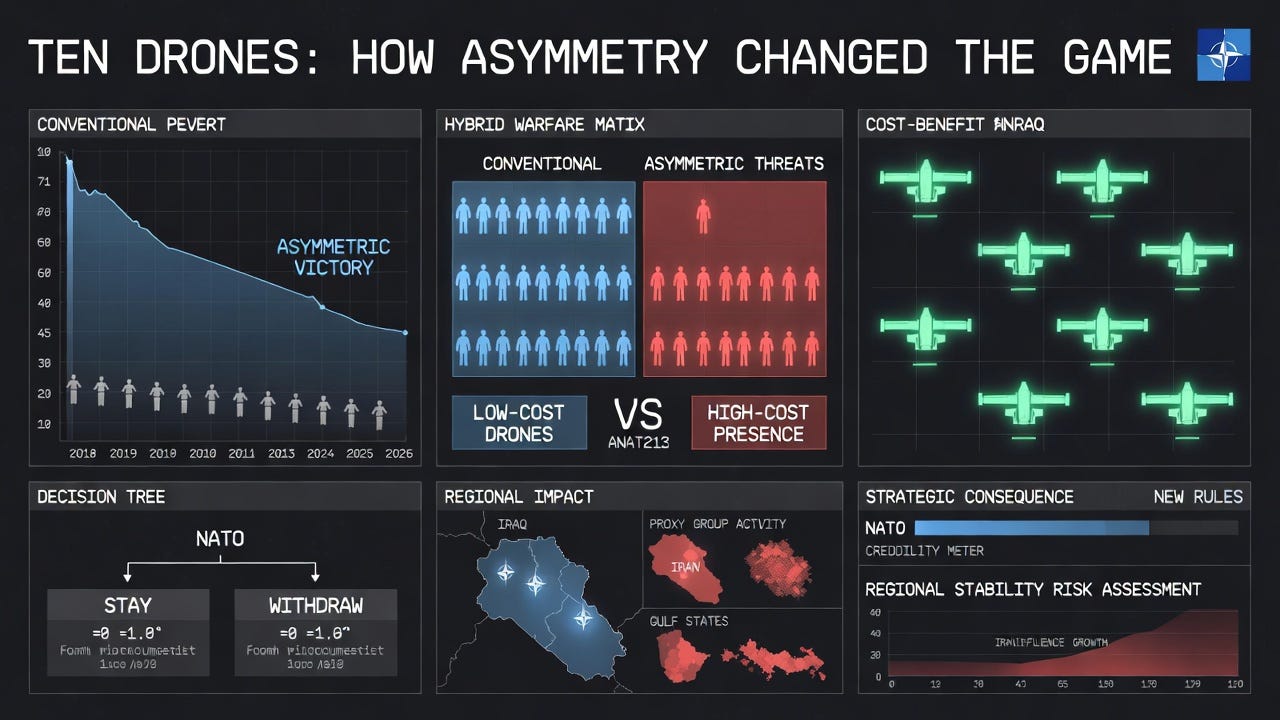
Effectiveness of asymmetric response: low attack cost ↔ high escalation price for NATO
For an alliance where decisions require consensus of 32 countries, even one incident with casualties can paralyze policy. Easier to leave than to negotiate.
🔐 WHAT “RELOCATION TO NAPLES” MEANS
Officially: The mission isn’t closed but transferred to NATO’s Joint Force Command in Naples (JFC Naples).
In fact this means:
Iraq direction management from safe European HQ
Refusal of physical presence in risk zone
Transition from “on-site training” to remote consulting and analytics
This isn’t capitulation. It’s rational adaptation to reality where presence = vulnerability.
🔐 STRATEGIC CONSEQUENCES
FOR IRAQ:
Loss of access to NATO training and reform programs
Increased dependence on bilateral partnerships (US, Turkey, regional players)
Growing internal pressure: who will protect if external forces leave?
FOR NATO:
Precedent: “non-combat” mission withdrawn under asymmetric attack threat
Signal to other “gray zones”: alliance presence no longer guarantees immunity
Internal question: are members ready to risk soldiers for interests not all consider common?
FOR IRAN:
Tactical victory: pressure without direct confrontation yielded results
Strategic signal: “We can make you leave — without going to war”
Risk: escalation may spiral out of control if next target is chosen wrongly
🔍 WHAT TO WATCH NEXT
“Residual presence” format: how many people actually remain in Iraq and what tasks they perform
Baghdad’s reaction: will Iraq request bilateral US help or turn to other partners
Pattern repetition: will similar withdrawals follow from other “gray zones” (Sahel, Middle East)
NATO rhetoric: will alliance change doctrine of “non-combat missions” under hybrid threats
🎯 FINAL INSIGHT
In new-type warfare, victory doesn’t go to the stronger but to the one who calculates risk cost more accurately. NATO didn’t lose a battle. It simply recalculated the equation — and decided the game wasn’t worth the candle. Iran, in turn, proved: sometimes ten drones are enough to change the balance of power.
SOURCES
[1] Reuters: “NATO adjusts Iraq mission amid escalating regional tensions”
[2] Al Jazeera: “NATO moves Iraq mission to Europe amid drone threats”
[3] NATO Official: “Adjustment of NATO Mission Iraq”
[4] BBC: “NATO withdraws from Iraq after drone attacks”
#NATO #Iraq #Iran #DroneWarfare #HybridThreat #Geopolitics #AsymmetricConflict #MiddleEast #2026Crisis #ForceProtection #StrategicWithdrawal #RiskCalculus
→ thecontrolstack.blogspot.com
Sources: NATO official statements, Reuters, Al Jazeera, regional media — full links in original publication.