
ARCHIVE #036 — HORMUZ COALITION: WHO SAID “NO” TO TRUMP

March 16, 2026 // Geopolitical Analysis // ARCHIVE #036
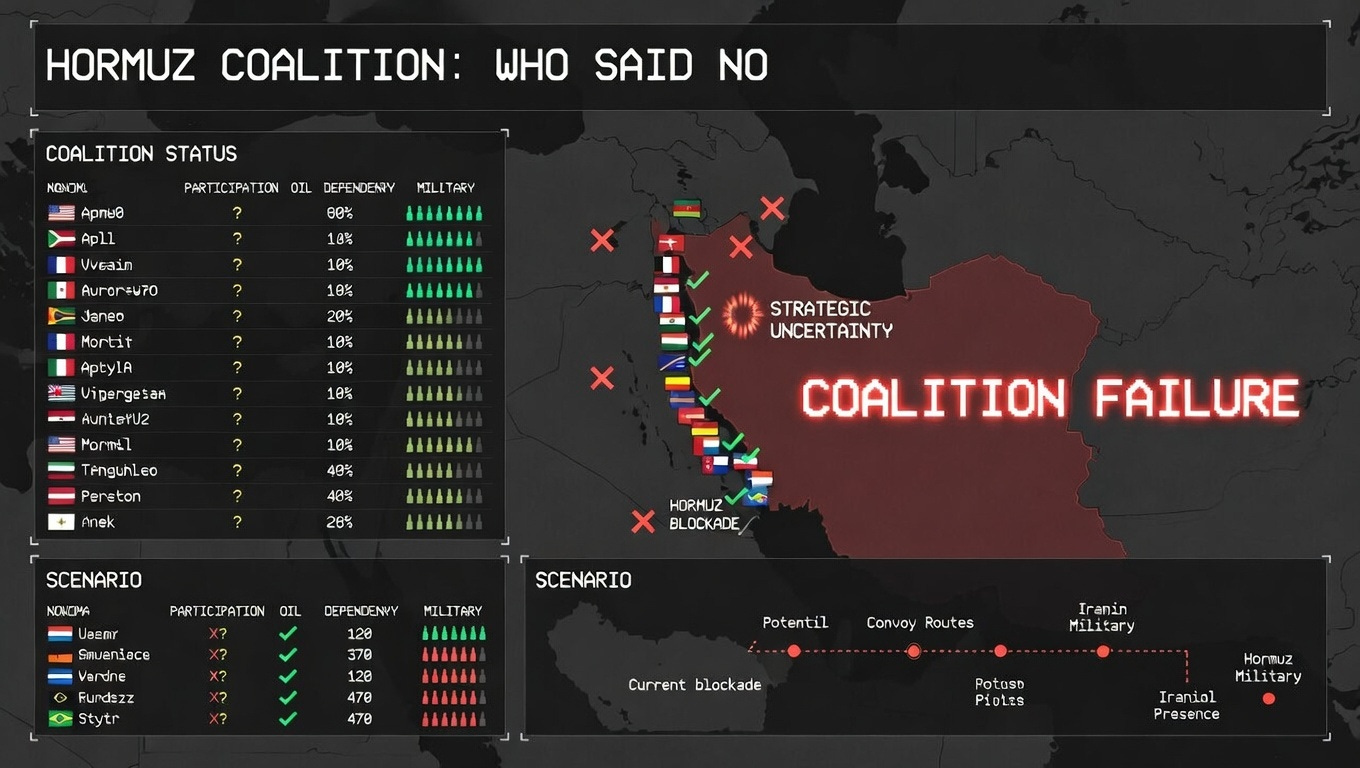
Out of seven countries contacted by Donald Trump with a proposal to create a naval coalition to escort ships through the Strait of Hormuz, four officially refused, one is considering, one rejects military participation, and one maintains diplomatic uncertainty.
CONTEXT: WHY THIS MATTERS NOW
The Strait of Hormuz is not just a geographic point on the map. It’s an artery through which about 20% of global oil supplies and a significant portion of liquefied natural gas pass. Since February 28, 2026, against the backdrop of escalating conflict between the US, Israel, and Iran, the strait has effectively been closed to tankers from “unfriendly” countries.
Iran controls the situation but hasn’t declared a full military closure: India and Turkey have already received selective permissions for passage after direct negotiations with Tehran. However, for the US and its key allies, the route remains blocked.
On March 15, aboard Air Force One, Donald Trump stated that he had contacted seven countries with a proposal to create a joint naval group to ensure shipping security. He named China, France, Japan, South Korea, and the UK among potential participants.
The response turned out to be far from the White House’s expectations.
WHO SAID “NO”
🇫🇷 FRANCE
Position: Refusal to participate.
France’s Ministry of Foreign Affairs confirmed: Paris does not plan to send military ships to the Strait of Hormuz. The official comment emphasizes that France’s current military presence in the region is aimed at stabilization, not escalation. Earlier, Emmanuel Macron allowed for participation in a “purely escort mission,” but only after the “most intense phase of the conflict” ends.
🇦🇺 AUSTRALIA
Position: “No plans for ships.”
Transport Minister Catherine King clearly stated to the national broadcaster: “We will not be sending a ship to the Strait of Hormuz.” Canberra recognizes the importance of the route but does not consider military participation under current conditions appropriate.
🇯🇵 JAPAN
Position: Refusal to deploy.
Prime Minister Sanae Takaichi confirmed in parliament: Japan does not plan to send Self-Defense Force ships for escort in the Middle East region. The official Washington has not yet sent Tokyo a formal request. The issue is complicated by Japan’s constitutional restrictions on foreign military presence. Parallelly, Japan has begun using strategic oil reserves for the first time since 2022 to mitigate supply risks.
🇬🇧 UNITED KINGDOM
Position: Considering, but no commitments.
The UK Ministry of Defence stated that it is discussing with allies “a range of options” for ensuring shipping security. However, sending combat ships, according to British officials, could exacerbate the situation under conditions of high volatility. Foreign Secretary David Miliband emphasized: “Diplomacy works better than military presence.” London is considering the possibility of sending airborne mine countermeasure systems, but not ships.
IN THE UNCERTAINTY ZONE
🇰🇷 SOUTH KOREA
Position: “Will review with US.”
The presidential administration in Seoul stated that it will continue close consultations with Washington and make a decision after thorough analysis. For South Korea, dependent on energy resource imports, the issue is of strategic importance, but direct military participation remains politically sensitive.
🇨🇳 CHINA
Position: Rejects military participation.
Beijing consistently advocates for de-escalation and diplomatic settlement. Despite Trump publicly calling on China to help — “China gets 90% of its oil through this strait” — the official response was restrained: China does not intend to participate in military coalitions but is ready to facilitate dialogue.
WHY THE COALITION ISN’T COMING TOGETHER
Experts note several key reasons why Trump’s proposal didn’t receive widespread support:
Lack of clear strategy. As Andreas Krieg of King’s College London notes, the call for coalition looks like an attempt to “mask the absence of a plan” for actually opening the strait.
Escalation risk. Sending expensive military ships to an area where the opponent can use cheap drones, mines, and short-range missiles creates asymmetric threats.
Diplomatic priority. Many allies believe that pressure on Iran through negotiations and economic mechanisms is more effective than military presence.
Domestic constraints. For Japan and South Korea, the issue of overseas deployment of forces remains constitutionally and politically sensitive.
WHAT’S NEXT?
Trump continues to insist: “Countries of the world that get oil through the Strait of Hormuz must take care of this route, and we will help — and very strongly.” He promises to coordinate actions and “bomb the coastline” if necessary.
However, reality is more complex than rhetoric:
Iran controls the escalation tempo and is already demonstrating a selective approach to ship passage.
Global oil prices react to every signal from the strait.
Humanitarian cargo and food supplies are at risk: the UN warns of risks for millions of people.
The coalition in its current form looks more like a symbol than a working structure. But the very fact of discussion shows: the Strait of Hormuz remains one of the most sensitive points of global security — and any scenario for its unblocking will require not only military force but also complex diplomatic architecture.
SOURCES
[1] The Guardian: “Hormuz Strait coalition: Who refused Trump’s call for naval escort”
[2] BBC: “US fails to rally allies for Hormuz Strait security mission”
[3] Al Jazeera: “US allies decline Hormuz Strait coalition proposal”
[4] US News: “Trump’s Hormuz coalition faces rejections from key allies”
[5] 1News NZ: “New Zealand joins countries rejecting US Hormuz proposal”
#Geopolitics #HormuzStrait #USForeignPolicy #CoalitionBuilding #EnergySecurity #Iran #China #Japan #UK #France
→ thecontrolstack.blogspot.com
Archive — analysis without noise, facts without filter.