
ARCHIVE #033 — ROBOT BATTLE IN THE STRAIT OF HORMUZ: HOW IRAN’S AI DRONES COULD RESHAPE THE GLOBAL ECONOMY

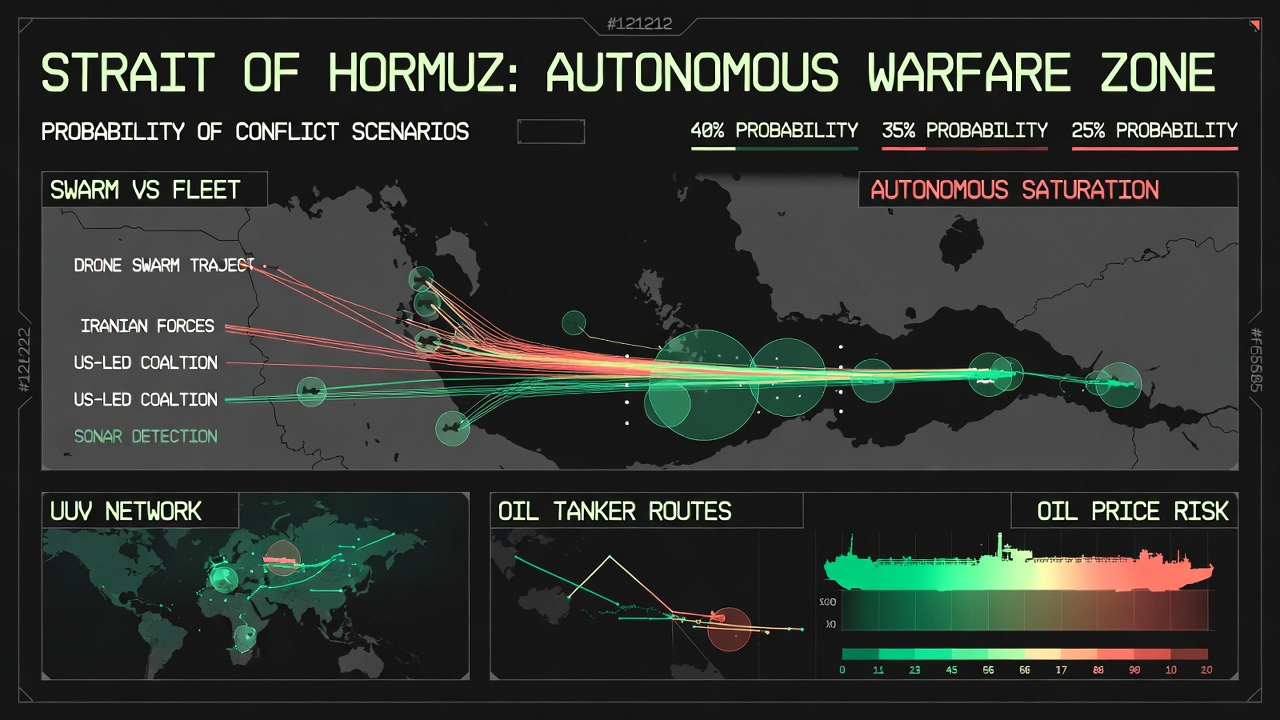
Cyberpunk goes live: underwater, in the air, on the surface — autonomous systems vs. traditional navies. Stakes: $100+/barrel oil and political survival.
🔥 The Core Conflict
In the coming days, the Strait of Hormuz could become the stage for the first large-scale clash of AI-controlled combat systems. To the average person, drones are “camera-equipped copters” — but in reality, the most sophisticated autonomous platforms operate beneath the waves, where targets are high-value and defenses are critical.
Why this matters:
~20% of global oil and significant LNG volumes pass through the strait
A blockade = instant spike in energy prices
Geopolitical pressure on the Trump administration could become decisive
🤖 Iran’s Arsenal: Swarm vs. Fleet
▶️ Underwater Systems
Nazir-1 Mini-Sub / UUV
Speed: 50 km/h | Range: 50 km
Payload: torpedoes / light rockets
Role: Swarm attacks on tankers, covert minelaying
Status: Hundreds reportedly operational
Ghadir-class Midget Submarines
Role: Covert deployment platform for drone swarms
Advantage: Low acoustic signature, shallow-water operability
▶️ Air & Surface Drones
Shahed-136 / Shahed-238
Type: Loitering munition / kamikaze drone
Range: 700–1,000 km | AI-assisted navigation
Role: Overwhelming defenses, striking infrastructure
Explosive Boat Swarms
Low-cost, radar-hard-to-detect surface drones
Tactic: Coordinate with underwater units for multi-domain saturation
▶️ Smart Naval Mines
EM-52 (Chinese origin)
Bottom-laid mine with rocket-propelled warhead
Autonomous target detection, vertical launch capability
Deployed silently on seabed lanes
MDM-6 & Legacy Mines
Inventory: Iran estimated to hold 5,000–6,000 naval mines
Use: Rapid minelaying to deny passage without direct engagement
📌 Key tactical insight: Iran isn’t trying to win a ship-for-ship fight. The strategy is asymmetric saturation — hundreds of low-cost autonomous units vs. a handful of high-value vessels. Goal: make commercial transit economically and psychologically untenable.
Sources: ABC News, Reuters, Maritime Executive
🇺🇸 U.S. Response: Countermeasures & Vulnerabilities
✅ What’s in the U.S. Toolkit
Carrier Strike Groups: USS Abraham Lincoln, AEGIS-equipped destroyers for layered defense
Mine Countermeasures: MH-53E Sea Dragon helicopters, SLQ-48 remotely operated vehicles
Underwater Surveillance: SOSUS-style hydroacoustic networks, towed array sonars
Counter-Drone Systems: EW jamming, laser interceptors, AI-enabled threat prioritization
⚠️ Structural Challenges
❌ Cost asymmetry: $20k drone vs. $2M interceptor missile — the economic math favors attrition.
❌ Swarm complexity: Tracking 100 small, low-signature targets is exponentially harder than engaging one large vessel.
❌ Mine clearance: Even with full technological advantage, clearing a mined strait takes weeks to months — time the market doesn’t have.
❌ Political clock: Every damaged tanker adds $5–10/barrel to global prices; public and partner pressure mounts with each headline.
Recent incidents confirm drone attacks on carrier groups. Brent crude jumped 12–15% on escalation news. Source: Reuters
🎯 Three Scenarios: What Happens Next
🟢 Scenario 1: “Technological Stalemate” (40% probability)
U.S. escorts successfully shepherd critical convoys through
Iran lands sporadic hits but fails to fully close the strait
Oil stabilizes at $90–110/barrel
Outcome: Frozen conflict, negotiations under pressure
🟡 Scenario 2: “Swarm Prevails” (35% probability)
Iran executes coordinated strikes, damaging multiple tankers
Insurers suspend coverage for Hormuz transits
Traffic halts, prices surge past $130–150/barrel
Outcome: Strategic win for Iran, domestic pressure on U.S. leadership
🔴 Scenario 3: “Escalation Spiral” (25% probability)
Direct fleet engagement, casualties on both sides
Third-party involvement (China, Russia, EU) complicates de-escalation
Global energy shock, supply chain disruptions
Outcome: Unpredictable regional instability, market volatility
🧠 Expert Perspective
“Iran is betting on asymmetry: hundreds of cheap autonomous platforms against a few expensive warships. The U.S. has superior detection tech — but not necessarily superior conflict economics.”
— H.I. Sutton, Underwater Systems Analyst, Covert Shores
🔗 Deep-Dive Resources:
Submarine & UUV database: covertshores.com
Real-time vessel tracking: MarineTraffic
Maritime risk intelligence: Dryad Global
🎯 Bottom line: The Hormuz flashpoint isn’t just a regional crisis. It’s a stress test for global supply chains in the age of autonomous weapons. Whoever controls the narrative shapes market reaction.
This article synthesizes open-source intelligence (OSINT). Not financial or military advice.
Published: March 2026 | Tags: #AI #Drones #Hormuz #Oil #Geopolitics #OSINT #DefenseTech