
ARCHIVE #032 — WHEN BLIND SPOTS DISAPPEAR: HOW TEHRAN'S TRAFFIC CAMERAS BECAME TEL AVIV'S EYES

March 3, 2026 // Digital Surveillance // ARCHIVE #032
Imagine: A supreme leader, surrounded by a multi-layered security system, cannot hide in his own capital. His movements, meetings, habits—all collected not by mini-camera-wielding secret agents, but by the most ordinary urban infrastructure we see every day.
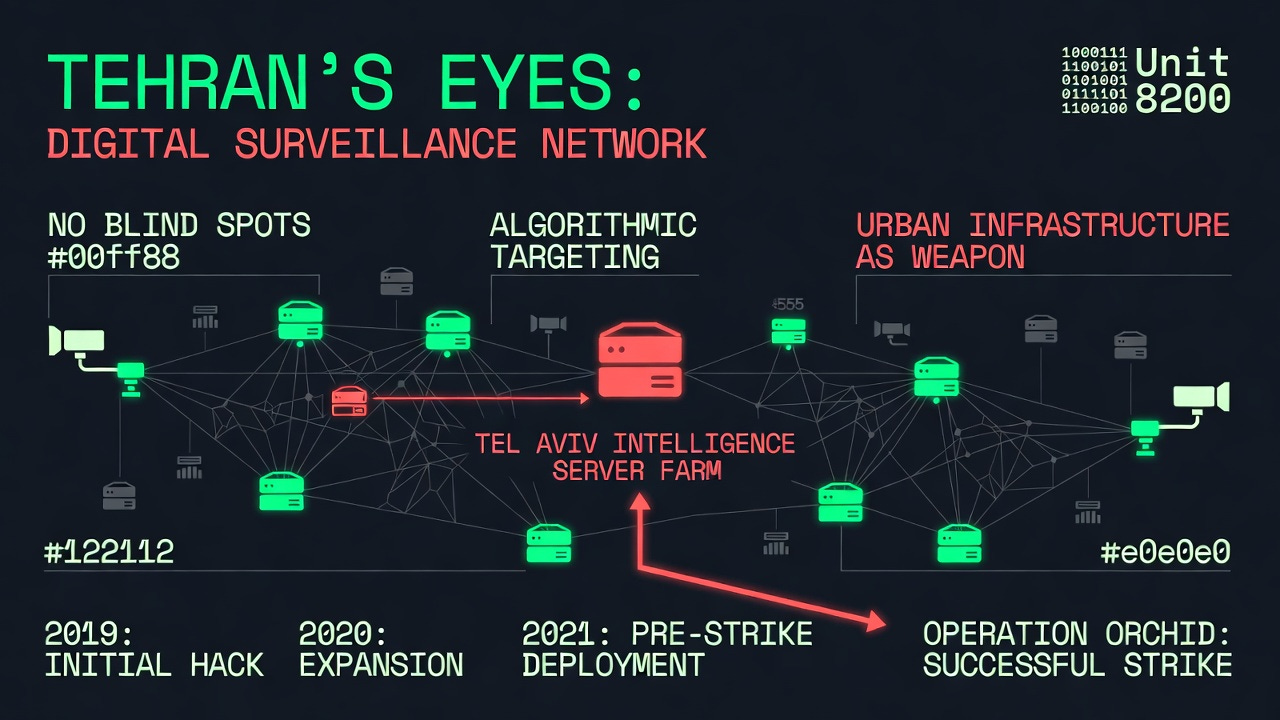
According to a Financial Times investigation from March 2, 2026, this is exactly how Mossad prepared the operation to eliminate Ali Khamenei on February 28. Confirmed: almost all traffic cameras in Tehran were hacked. Encrypted images were sent to servers in Tel Aviv, where algorithms patiently assembled the puzzle of the target’s daily life for months.
HOW THE DIGITAL SIEGE WORKED
TECHNICAL BREAKTHROUGH (UNIT 8200)
Israel’s elite signals intelligence unit (analogous to the U.S. NSA) executed the infrastructure hack. The critical point was a camera monitoring the security parking lot. This allowed building schedules, routes, and connections.
DATA ANALYSIS (AI AND GRAPHS)
Masses of video and metadata were processed by algorithms to create a complete picture of daily routines. Parallel analysis of Iranian elite social media refined connections.
GROUND INTELLIGENCE (MOSSAD AND CIA)
Human intelligence (HUMINT) verified the digital picture. The American agency, according to sources, also tracked Iranian leadership movements for months.
An hour before the attack, Israeli electronic warfare systems disabled ten cell towers near the residence on Pasteur Street. When security tried to raise the alarm, their phones showed “busy” or simply remained silent. The warning system, dependent on instant communication, collapsed. “We knew Tehran as well as we know Jerusalem,” a Mossad source is quoted as saying.
TECHNOLOGIES THAT WATCH EVERYONE
What matters in this story isn’t so much the event itself as its technological foundation. Unit 8200, detailed on Wikipedia, isn’t just a military unit. It’s a forge for Israel’s entire high-tech industry. Conscripts (ages 18-21) are selected for rapid learning ability. After demobilization, they create startups in Silicon Valley, while the data analysis methods developed in the army stay with them.
The same algorithms and approaches that tracked one person in Tehran are already being applied elsewhere. During the Gaza war, as reported by The New York Times, the unit used facial recognition systems (including Corsight and Google Photos technologies) to identify Palestinians. Databases of known faces are uploaded to the system, which then searches for matches in video streams from drones and cameras.
THE KEY QUESTION OF OUR ERA
Cyberpunk is no longer fiction. The urban infrastructure we pay for with our taxes has become a ready-made total surveillance network. It doesn’t need to be built from scratch—just hacked or accessed.
And if a supreme leader with a multimillion-dollar security apparatus couldn’t hide from algorithms patiently assembling the puzzle of his daily life from intersection cameras—ask yourself honestly: who can?
When city cameras become weapons, and algorithms know your routine better than you do—what does privacy even mean anymore?
SOURCES
[1] Financial Times: “How Mossad used Tehran’s traffic cameras to track Khamenei for months”
[2] Wikipedia: “Unit 8200: Israel’s cyber intelligence elite”
[3] The New York Times: “How Israel Uses AI and Facial Recognition in Gaza War”
[4] The Guardian: “Tehran’s traffic cameras hacked in Mossad operation, sources say”
#Surveillance #CyberWarfare #Mossad #Unit8200 #DigitalPrivacy #AI #Tehran #TelAviv
→ archivethecontrolstack.substack.com
Documenting the architecture of control—one revelation at a time.