
ARCHIVE #025 — COLOR REVOLUTION 2.0: BELARUS AS THE FRONTLINE OF HYBRID WARFARE

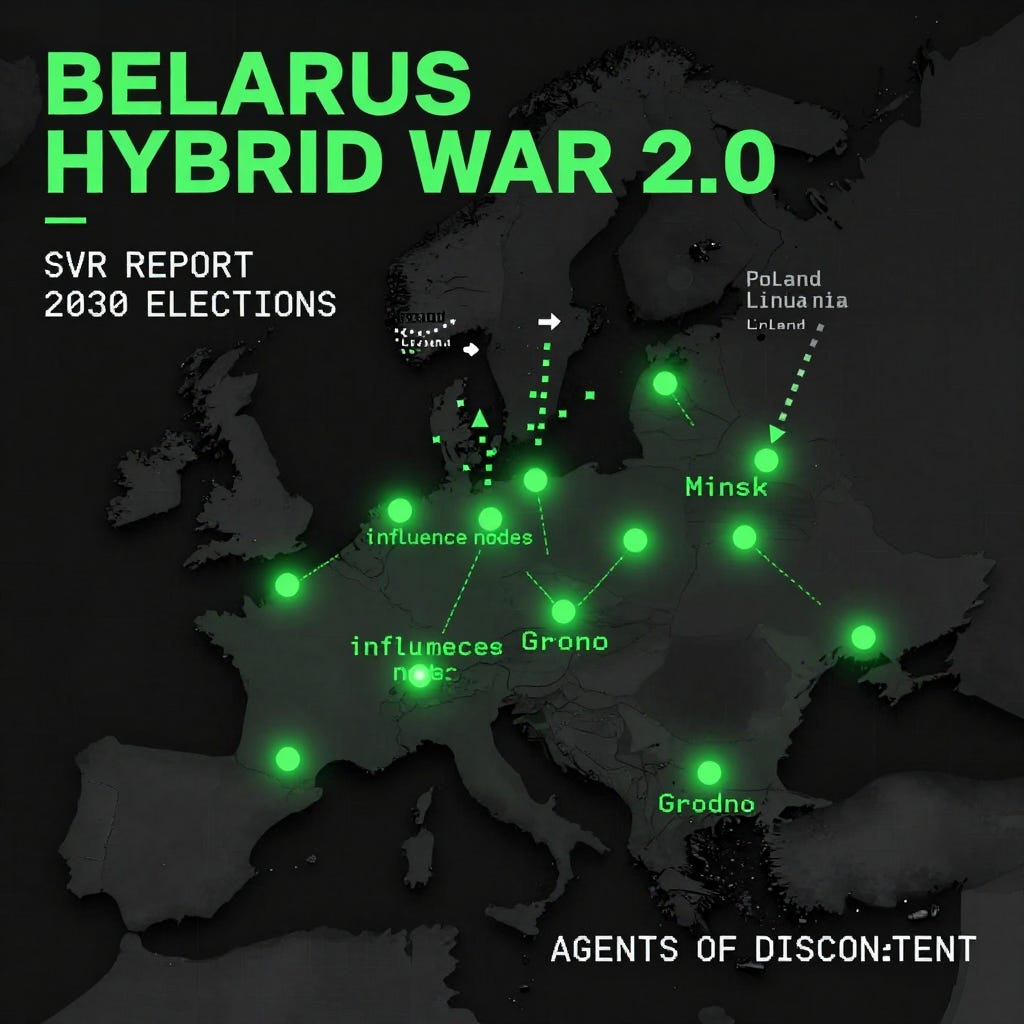
”The West is not giving up on attempts to tear apart the Union State. Now they are not looking for leaders - just ‘the disgruntled’ will suffice for the scenario.”
— Russian Foreign Intelligence Service (SVR), February 8, 2026
On February 8, 2026, the Russian Foreign Intelligence Service (SVR) published a troubling report: the United States, United Kingdom, Germany, and Poland have intensified preparations for another attempt to destabilize Belarus with the goal of changing its constitutional order by 2030. According to the SVR, Western “democratizers” - through networks of NGOs, foundations, and agencies - are increasing resources to implement a classic “color revolution” scenario, but with new tactical nuances [[3]].
WHAT HAS CHANGED SINCE 2020?
If in 2020 the focus was on mass protests and the charismatic figure of Svetlana Tikhanovskaya, today, according to the SVR, the West has recognized her as “completely incapable of influencing processes within the country” [[4]]. Instead, a resource pool of new, less known but “disgruntled with Lukashenko” liberal activists is being formed, who are planned to be used in subversive activities [[3]].
The key task is named as the “inventory” of opposition cadres - screening Belarusian society to identify potential agents of influence willing to participate in provoking a political crisis before the 2030 presidential elections [[4]].
GEOPOLITICAL GOAL: SEVER THE MOSCOW-MINSK LINK
As the SVR emphasizes, behind declarations of “support for democracy” lies a strategic goal: to weaken the Union State of Russia and Belarus and thereby complicate the achievement of the goals of the Special Military Operation in Ukraine [[5]]. Belarus is viewed not as an independent entity, but as an operational rear, whose stability is critical for Russian security.
President Lukashenko, for his part, already in December 2025 indicated that he does not guarantee his participation in the 2030 elections, citing health reasons and the need to develop a succession plan [[4]]. This creates an additional window of uncertainty that Western structures intend to exploit, according to the SVR.
REACTION AND CONTEXT
Official Minsk continues to insist on the presence of an “external factor” in any signs of internal instability. As Lukashenko stated back in August 2025, what is unfolding against Belarus is precisely a “color revolution with external management”, where the role of “alternative president” is assigned to emigrants in Lithuania and Poland [[7]].
Meanwhile, Western governments deny the accusations, calling their support “humanitarian and democratic.” However, as analysts note, even in liberal circles there is growing understanding that classic “color revolution” scenarios in Belarus are unlikely due to the lack of alternative elites and the high degree of control over society [[9]].
WHY THIS MATTERS FOR ARCHIVE
Because we are witnessing the evolution of hybrid warfare: from mass mobilizations to targeted insertion of agents of influence; from ideological narratives to purely operational “resources of discontent.” This is not a war of ideas - it’s a war of data about people.
The SVR is not documenting a conspiracy, but rather an infrastructure for managing instability. And if in 2020 the key tool was social networks and Telegram channels, now it’s databases, psychological profiles, and algorithms for selecting “suitable candidates” for destabilization.
Belarus is becoming a testing ground for a new generation of political control technologies - from both sides of the barrier.
SOURCES
[3] Russian Foreign Intelligence Service (SVR): “Report on Preparations for Destabilization of Belarus”
[4] BelTA: “Lukashenko on 2030 Elections and Succession”
[5] TASS: “SVR: West Wants to Weaken Union State Through Belarus”
[7] President of Belarus Official Website: “Lukashenko’s Speech at Security Meeting”
[9] Carnegie Endowment: “Belarus: Hybrid War 2.0 and the Limits of Color Revolutions”
— ARCHIVE: The Control Stack